Second Circuit Revisits Elements of Scheme Liability in SEC v. Rio Tinto

Since the Second Circuit’s holding in Lentell v. Merrill Lynch & Co., 396 F.3d 161 (2005) (“Lentell”), it has been settled law in the Second Circuit that misstatements and omissions alone do not suffice to impose scheme liability on individuals who did not “make” alleged misstatements under Rule 10b-5(a) and (c) of Section 10(b) of the Securities Exchange Act.  

Recently, in SEC v. Rio Tinto PLC, 41 F.4th 47, 49 (2022), the SEC asked the Second Circuit to consider whether Lentell should be abrogated in light of the Supreme Court’s decision in Lorenzo v. SEC, 139 S. Ct. 1094 (2019) (“Lorenzo”). The SEC argued that Lorenzo had expanded the scope of the scheme subsections of Rule 10b-5a by ruling that an individual who disseminated a false statement (but did not make it) could be liable under the scheme subsections. Rio Tinto, 41 F.4th at 48-49, 52. For that reason, the SEC maintained that its scheme liability claims against Rio Tinto’s CEO and CFO should be allowed to proceed even though the only fact it had alleged to support their participation in a scheme was defendants’ “fail[ure] to prevent misleading statements from being disseminated by others.” Id. at 52. According to the SEC, “misstatements and omissions alone” should be enough to “form the basis for scheme liability,” so its pleading was more than sufficient. Id.   

The Second Circuit disagreed, finding that the SEC’s overly broad reading of Lorenzo would undermine two key features of Rule 10b-5(b).

  • First, the Supreme Court’s holding in Janus Capital Group, Inc. v. First Derivative Traders, 564 U.S. 135, 142 (2011), limits primary liability under Rule 10b-5(b) to the “maker” of a statement. Rio Tinto, 41 F.4th at 52. An expanded scope of scheme liability like that proposed by the SEC would enable a plaintiff to prove that a defendant is primarily liable under the scheme subsections for mere “participation in the making of [] misstatements,” for example by helping to prepare them or, in this case, failing to prevent their dissemination. Id. 

  • Second, misstatements and omissions claims brought by private plaintiffs under Rule 10b-5(b) are subject to a heightened pleading standard. Rio Tinto, 4 F.4th at 52. This heightened standard does not apply to allegations of scheme liability because scheme liability does not require an allegation that the defendant made a statement. Id.

In addition, the Second Circuit found that Lorenzo did not abrogate Lentell because the two decisions are consistent with each other. Rio Tinto, 4 F.4th at 53. Though Lorenzo held that the “dissemination of false or misleading statements with intent to defraud” does come within the scheme subsections, the mere fact of the misstatements or omissions was not the sole basis for scheme liability in Lorenzo (as Lentell requires). Id. The defendant’s act of disseminating those misstatements constituted the “act” or “conduct” sufficient to invoke scheme liability. Id.

***

Please contact Alto Litigation partners Bahram Seyedin-Noor (bahram@altolit.com) or Bryan Ketroser (bryan@altolit.com) if you require counseling on a securities litigation matter.

****

Disclaimer: Materials on this website are for informational purposes only and do not constitute legal advice. Transmission of materials and information on this website is not intended to create, and their receipt does not constitute, an attorney-client relationship. Although you may send us email or call us, we cannot represent you until we have determined that doing so will not create a conflict of interests. Accordingly, if you choose to communicate with us in connection with a matter in which we do not already represent you, you should not send us confidential or sensitive information, because such communication will not be treated as privileged or confidential. We can only serve as your attorney if both you and we agree, in writing, that we will do so.

The materials on this website are not intended to constitute advertising or solicitation. However, portions of this website may be considered attorney advertising in some states.

Unless otherwise specified, the attorneys listed on this website are admitted to practice in the State of California.


The SEC Strikes At Crypto Assets In First of Its Kind Enforcement Action

bitcoin standing up on desk with other coins and chart in background

The Securities and Exchange Commission swatted the proverbial hornet’s nest in a first-of-its-kind insider trading action involving digital assets listed for trading on a major trading platform. While insider trading actions are common, the SEC made headlines by alleging for the first time that nine digital assets traded on Coinbase Global, Inc., one of the largest crypto asset trading platforms in the United States, satisfied the legal definition of “securities,” giving the SEC jurisdiction to bring charges under the anti-fraud provisions of the federal securities laws.

The SEC’s complaint filed on July 21 in the United States federal district court in Seattle alleged that Ishan Wahi, a manager in Coinbase’s assets and investing products group, repeatedly provided his brother Nikhil Wahi and a close friend, Sameer Ramani, with information about the timing and content of Coinbase’s announcements that the company would list cryptocurrency assets on its trading platform, in violation of Coinbase’s confidentially requirements.  Nikhil and Ramani allegedly made at least $1.1 million by trading ahead of the announcements.

According to the SEC, between at least June 2021 and June 2022, blockchain addresses linked to Nikhil and Wahi traded ahead of (sometimes by just minutes) more than ten announcements involving at least 25 crypto assets, nine of which were “crypto asset securities.”  The SEC’s complaint asserted that these digital assets satisfied the definition of investment contracts in SEC v. W.J. Howey Co., 328 U.S. 293 (1946) because they were offered and sold to investors who made an investment of money in a common enterprise, with a reasonable expectation of profits derived from the efforts of others.  

More specifically, the SEC explained, each of the nine crypto asset securities were offered and sold by an issuer to raise money for the issuer’s business. The issuers and their promoters solicited investors by touting the potential for profits and the ability of investors to engage in secondary trading of their tokens, with the success of the investment depending on the efforts of management and others at the company. These representations were made through white papers, websites, social media, messaging systems and platforms such as Twitter, YouTube and Medium.[1] Thus, the SEC asserted that the nine crypto securities invited investment on the promise that managerial efforts and the availability of secondary trading would increase the value of the tokens, which were the “hallmarks” of a security.  

The SEC is seeking injunctions, civil monetary penalties, and disgorgement for violations of Section 10(b) of the Securities Exchange Act and Rule 10b-5 thereunder. In a parallel action, the U.S. Attorney for the Southern District of New York brought criminal charges against the Wahi brothers and Ramani for wire fraud and wire fraud conspiracy, not insider trading. The Wahi brothers have pleaded not guilty to the charges, while Ramani is still at large.

The reaction to the SEC’s action was swift and scalding. Critics accused the SEC of pursuing “regulation by enforcement” rather than taking a regulatory approach. Coinbase stated that it does not list securities for trading and petitioned the SEC to propose new rules for the offer, sale, registration and trading of digital assets, including rules that would identify which assets are securities. Even Commissioner Caroline Pham of the Commodities and Futures Commission blasted the SEC and stated that the action could have broad implications beyond a single case, while underscoring the need for regulators to work together. The CFTC has asserted enforcement jurisdiction over fraudulent or manipulative activity in virtual digital currencies like Bitcoin and Ether, but has not asserted “registration jurisdiction.”

There are at least two potential roadblocks to future SEC actions. First, the outcome of court rulings, such as in the Wahi action and SEC v. Ripple Labs, Inc., where the SEC has alleged that the XRP digital asset should be registered as a security. Second, a bipartisan bill has been introduced in the Senate that would create a regulatory structure for digital assets, including a standard for determining which are commodities and which are securities.

In the meantime, digital asset companies and related exchanges face heightened risks. The SEC’s action demonstrates that the agency is prepared to bring enforcement actions based on the Division of Corporation Finance’s April 2019 “Framework for ‘Investment Contract’ Analysis of Digital Assets” that applied the Howey test to determine whether crypto assets are securities.  The SEC has beefed up hiring for the newly created Crypto Assets and Cyber Unit, while SEC Chair Gary Gensler stated that when digital assets function as securities they will be treated as such.  

***

Please contact Alto Litigation partners Bahram Seyedin-Noor (bahram@altolit.com) or Bryan Ketroser (bryan@altolit.com) if you require counseling on a securities litigation matter.

****

Disclaimer: Materials on this website are for informational purposes only and do not constitute legal advice. Transmission of materials and information on this website is not intended to create, and their receipt does not constitute, an attorney-client relationship. Although you may send us email or call us, we cannot represent you until we have determined that doing so will not create a conflict of interests. Accordingly, if you choose to communicate with us in connection with a matter in which we do not already represent you, you should not send us confidential or sensitive information, because such communication will not be treated as privileged or confidential. We can only serve as your attorney if both you and we agree, in writing, that we will do so.

The materials on this website are not intended to constitute advertising or solicitation. However, portions of this website may be considered attorney advertising in some states.

Unless otherwise specified, the attorneys listed on this website are admitted to practice in the State of California.



[1] The SEC cast a skeptical eye on white papers by observing that they often used “pseudo-technical jargon”.

Can Plaintiffs Avoid Discovery Sequencing When Bringing a Trade Secret Claim in California District Court?

Every trade secret plaintiff in California state court knows they will have to wage battle over whether they have identified their alleged trade secrets with reasonable particularity before discovery “relating to the trade secret” may commence. [1] What if a plaintiff could evade this albatross by filing (when procedurally appropriate) in federal court?  

The recent holding in Skye Orthobiologics, LLC, et al. v. CTM Biomedical, LLC, et al. (“Skye Orthobiologics”), No. 20-cv-03444-DMG-PVCX, 2021 WL 6102432 (C.D. Cal. Aug. 27, 2021), suggests there may be that possibility.

While the Ninth Circuit has yet to squarely decide whether Section 2019.210 applies to federal actions asserting a claim under the California Uniform Trade Secrets Act (“CUTSA”), district court decisions have generally come out one of three ways:

(1) those holding that the discovery restriction does not conflict with the Federal Rules of Civil Procedure and is fully applicable, an approach “routinely” taken by courts in the Northern District of California (e.g., Openwave Messaging, Inc. v. Open-Xchange, Inc., No. 16-cv-00253-WHO, 2018 WL 2117424, at *4 (N.D. Cal. May 8, 2018) (collecting cases));

(2) those holding that the restriction conflicts with Rule 26 of the Federal Rules and is not applicable (e.g.,Hilderman v. Enea TekSci, Inc., No. 5-cv-01049-BTM-AJB, 2010 WL 143440, at *2-3 (S.D. Cal. Jan. 8, 2010)); and

3) those holding that a federal court may use the Federal Rules to fashion appropriate protections in a particular case, which may be similar to the California restrictions in order to advance the same objectives served by the California statute (e.g., Jardin v. DATAllegro, Inc., No. 10-cv-2552-IEG-WVG, 2011 WL 3299395, at *3-5 (S.D. Cal. July 29, 2011)).

Conversion Logic, Inc. v. Measured, Inc., No. 19-cv-05546-ODW-FFMX, 2020 WL 2046391, at *2 (C.D. Cal. Jan. 16, 2020). These cases, however, did not examine the scenario of how the court should approach discovery sequencing when the plaintiff brings its trade secret claim under the Defense of Trade Secret Act (“DTSA”), a federal statute, but does not bring a CUTSA claim.

This scenario was recently considered in Skye Orthobiologics. In Skye Orthobiologics, plaintiff asserted a DTSA claim only – and no CUTSA claim. See Skye Orthobiologics, 2021 WL 6102432 at *8.  Unlike CUTSA, DTSA does not require a plaintiff to identify its trade secrets before any other party must respond to discovery.  Id. at *6-7. Therefore, the Sky Orthobiologics court reasoned that the “‘absence of . . . a discovery [sequencing] procedure in DTSA . . . support[s] the inference that a plaintiff . . . is entitled to discovery in accordance with the general discovery rules set forth in Federal Rule of Civil Procedure 26.’”  Id. at *7. While recognizing the broad discretion afforded to district courts to craft discovery orders that “set the timing and sequence of discovery,” the court found no “case-specific considerations” that would a more detailed disclosure of plaintiff’s alleged trade secrets than was set forth in the complaint.  Id. at *8. Hence, the court ruled that each side could “proceed with discovery simultaneously, and expeditiously.”  Id.

 Based on our own very informal survey of filings in California District Courts over the last six months, we found approximately twice as many plaintiffs asserted DTSA and CUTSA claims as opposed to DTSA claims only. It will be interesting to see whether, and how widely, district courts adopt this reasoning when faced with the less common scenario of a plaintiff asserting a DTSA claim with no accompanying CUTSA claim. Until then, decisions in other jurisdictions** suggest a growing trend of courts from around the country to require a trade secret plaintiff to identify its trade secrets with “reasonable particularity” before it may commence discovery relating to those trade secrets. 

***

Please contact Alto Litigation partners Bahram Seyedin-Noor (bahram@altolit.com) or Bryan Ketroser (bryan@altolit.com) if you require counseling on a trade secret litigation matter.

****

Disclaimer: Materials on this website are for informational purposes only and do not constitute legal advice. Transmission of materials and information on this website is not intended to create, and their receipt does not constitute, an attorney-client relationship. Although you may send us email or call us, we cannot represent you until we have determined that doing so will not create a conflict of interests. Accordingly, if you choose to communicate with us in connection with a matter in which we do not already represent you, you should not send us confidential or sensitive information, because such communication will not be treated as privileged or confidential. We can only serve as your attorney if both you and we agree, in writing, that we will do so.

The materials on this website are not intended to constitute advertising or solicitation. However, portions of this website may be considered attorney advertising in some states.

Unless otherwise specified, the attorneys listed on this website are admitted to practice in the State of California.


**See Vesta Corp. v. Amdocs Management Ltd., 147 F. Supp. 3d 1147, 1152 (D. Or. 2015) (citing Engelhard Corp. v. Savin Corp., 505 A.2d 30, 33 (Del. Ch. 1986), Xerox Corp. v. International Business Machines Corp., 64 F.R.D. 367, 371–72 (S.D.N.Y. 1974); DeRubeis v. Witten Technologies, Inc., 244 F.R.D. 676, 680–81 (N.D. Ga. 2007); Automed Techs., Inc. v. Eller, 160 F. Supp. 2d 915, 926 (N.D. Ill. 2001); Dura Global Technologies, Inc. v. Magna Donnelly, Corp., No. 7-cv-10945, 2007 WL 4303294, at *2 (E.D. Mich. 2007); Del Monte Fresh Produce Co. v. Dole Food Co., Inc., 148 F. Supp. 2d 1322 (S.D. Fla. 2001); and Ikon Office Solutions v. Konica Minolta Business Solutions, No. 8-cv-0539-RLV-DCK, 2009 WL 4429156, at *4–5 (W.D.N.C. Nov. 25, 2009) and noting “[t]his list is not exhaustive.”).


[1] For an analysis of how California courts determine what constitutes “discovery relating to the trade secret,” in the context of California Code of Civil Procedure section 2019.210 (“Section 2019.210”) see our prior article.

The DTSA and Disgorgement: A Look at the “Avoided Costs” Theory of Damages

Can trade secret damages actually exceed the value of the stolen technology to the infringer? Yes, according to the “avoided costs” theory of damages, which is currently on appeal in the Second Circuit.

 Damages in trade secrets cases can be notoriously difficult to quantify. This is particularly true where the plaintiff has suffered no direct harm in the form of lost profits. But federal courts have increasingly endorsed the “avoided costs” damages remedy, which may arguably leave a plaintiff with substantial damages and in a better position than had the misappropriation never occurred.   

 A form of unjust enrichment, the “avoided costs” theory seeks to recover “the wrongful gain to the party that misappropriated the trade secret.” Syntel Sterling Best Shores Mauritius Ltd. v. TriZetto Grp., Inc., No. 15 CIV. 211 (LGS), 2021 WL 1553926, at *7 (S.D.N.Y. Apr. 20, 2021). This “wrongful gain” may be quantified as the research and development funds saved by the defendant, which the plaintiff may recover in full.  Id. at *6-7. Notably, a plaintiff may use its own research and development costs as a proxy for what the defendant “saved” by virtue of the misappropriation.  Id. at *7. In effect, this may allow the harmed party to recover all research and development costs associated with the misappropriated technology. This outcome may arguably leave the plaintiff better off than had the misappropriation never occurred:  the plaintiff may continue to reap the benefits of its own technology while having its research costs subsidized by the infringer. Nonetheless, the “avoided costs” remedy has been endorsed as a proper measure of damages in a trade secrets case. Id.

Syntel Sterling offers a choice example. In that case, TriZetto accused Syntel of misappropriating trade secrets under the Defend Trade Secrets Act (“DSTA”).  Id. at *1. The trade secrets included software tools aimed at improving complex installation, upgrading, and customization processes relating to the autonomous management of health insurance claims. Id. After establishing liability, TriZetto sought damages, the amount that Syntal saved in development costs, using TriZetto’s own development costs as a proxy. Id. at *7.  In doing so, TriZetto argued that Syntal benefited from the misappropriation with “early entry” into complex consulting market without having had to develop the necessary technology required for such services. Id. at *8. At trial, TriZetto sought more than $284 million in “avoided cost” damages, which the jury awarded in full. Id. at *1.  

Post-trial, Syntal moved for a judgment as a matter of law on all claims. Id. *1. In seeking to undo the damages award, Syntal first argued that TriZetto should not receive the total value of a trade secret when TriZetto still received value from the trade secrets. Id. at *7. In other words, the total “avoided damages” award overcompensated TriZetto, who was still making money from the misappropriated technology. See id. In rejecting this argument, the district court held that the DTSA expressly permits the recovery of unjust enrichment damages, which should not logically depend on the “continuing value of the trade secret to the claimant,” and “do not require a corresponding loss to the plaintiff[.]”. Id. It rather was aimed at disgorging a wrongdoer from ill-gotten gains.  Id.  

Syntel next argued that “avoided costs” should not be awarded when the claimant’s “actual loss” (in the form of lost profits) and Syntal’s “actual enrichment” (in the form of increased revenues) could easily be measured. Id. But the court rejected these arguments as well. Id. In rejecting the “actual loss” argument, the court held that the DTSA expressly allows recovery of both actual loss and unjust enrichment, so long as there is no double counting. Id. In rejecting the “actual enrichment” argument, the court acknowledged that measuring actual enrichment to Syntel may be one way to measure unjust enrichment damages, but awarding “avoided costs” may be a more appropriate measure of damages where the infringer (Syntel) enjoyed only modest profit or even no profit. Id. The wrongdoer, not the aggrieved party, should bear the business risk that the wrongful use of the secrets will not be profitable. Id.    

Syntel Sterling is currently pending on appeal before the Second Circuit. It remains to be seen whether TriZetto’s damages theory will be upheld. But if upheld, the Second Circuit will affirm the nature of the “avoided cost” remedy, allowing a claimant to recover its entire research and development costs associated with the misappropriated technology. This is true even if the claimant itself retains profitable use of the trade secrets; the claimant otherwise suffered only modest (but measurable) direct financial harm, and the defendant itself benefited little from the misappropriation.

***

Please contact Alto Litigation partners Bryan Ketroser (bryan@altolit.com) or Bahram Seyedin-Noor (bahram@altolit.com) if you require counseling on a trade secret litigation matter.

****

Disclaimer: Materials on this website are for informational purposes only and do not constitute legal advice. Transmission of materials and information on this website is not intended to create, and their receipt does not constitute, an attorney-client relationship. Although you may send us email or call us, we cannot represent you until we have determined that doing so will not create a conflict of interests. Accordingly, if you choose to communicate with us in connection with a matter in which we do not already represent you, you should not send us confidential or sensitive information, because such communication will not be treated as privileged or confidential. We can only serve as your attorney if both you and we agree, in writing, that we will do so.

The materials on this website are not intended to constitute advertising or solicitation. However, portions of this website may be considered attorney advertising in some states.

Unless otherwise specified, the attorneys listed on this website are admitted to practice in the State of California.

Section 2019.210 and the Need for Better Boundaries That Define “Discovery Relating to the Trade Secret”

Trade secret litigants in California are well versed in the general requirements of Code of Civil Procedure Section 2019.210, as it imposes a unique sequencing to the order of discovery. In a non-trade secrets case, the plaintiff may (with few exceptions) commence discovery 10 days after service of the summons and complaint while the defendant can serve discovery at any time. Cal. Code Civ. Proc. §§ 2030.020, 2031.020, 2033.020. In a trade secret case, however, this general rule does not apply. The Section provides (with emphasis added):  

“In any action alleging the misappropriation of a trade secret under the Uniform Trade Secrets Act . . . , before commencing discovery relating to the trade secret, the party alleging the misappropriation shall identify the trade secret with reasonable particularity . . . .”

While California courts have provided substantial guidance on what it means to identify a trade secret with “reasonable particularity,”[1] few published decisions have addressed the issue of what constitutes “discovery relating to the trade secret.” Does it mean discovery related solely to the trade secret cause of action? Does it mean discovery related solely to those trade secrets that the Court first determines have been identified with reasonable particularity? Does Section 2019.210 “discovery relating to the trade secret” extend to other causes of action – including breach of contract – that might “relate to” the trade secret claim? And what if the same body of discovery that “relat[es] to the trade secret” also relates to the defendant’s cross-claims or one or more non-trade secret causes of action asserted by the plaintiff? While the letter of the law is not crystal clear, the Court’s holding in Advanced Modular Sputtering, Inc. v. Super. Ct., 132 Cal. App. 4th 826 (2005) (“Advanced Modular”) provides some critical guidance.

Advanced Modular

In a case of first impression, the Court in Advanced Modular considered whether the reach of Section 2019.210 extended beyond the asserted trade secret claim to prohibit discovery on “any cause of action that relates to the trade secret.”

In Advanced Modular, the plaintiff argued that it should have been permitted to commence discovery on its nine non-trade secret causes of action – which included contract, tort and equitable claims – before identifying its trade secrets with particularity. Id. at 834-35. The court rejected the plaintiff’s argument because it ruled a “fair reading” of the complaint “compels the conclusion that each and every cause of action hinges upon the factual allegation that [defendant] misappropriated [plaintiff’s] trade secrets.” Id. at 834 (emphasis added). For example, the only alleged basis for the plaintiff’s breach of contract claim was that the defendants had breached their confidentiality agreements by “disclosing the trade secrets.” Id. The contract claim alleges no other breach. Id. Similarly, every other cause of action “incorporate[d] and depend[ed] upon the foundational allegation that petitioners ha[d] misappropriated . . . trade secrets.” Id. at 831; see also id. at 834. Based on its express finding that every cause of action was “factually dependent on the misappropriation allegation,” the court ruled that discovery could commence only after the allegedly misappropriated trade secrets had been identified with reasonable particularity. Id. at 834-35 (emphasis added).

Thus, Advanced Modular stands for the proposition that a cause of action must “hinge[] upon” or be “factually dependent on” the trade secret allegation in order for the Section 2019.210 discovery stay to extend to that cause of action. That guidance, however, does not go far enough. In fact, in Advanced Modular the Court readily recognized the limited reach of its holding, noting: “[w]hile we can envision an ‘action’ alleging misappropriation in some causes of action but not in others, the instant ‘action’ is not one of them.”  Id. at 834. California appellate courts have yet to consider three related issues: (1) whether and to what extent discovery should proceed when one or more of the causes of action do not “hinge upon” or “factually depend on” the trade secret claims; (2) whether the plaintiff may proceed with discovery as to the trade secrets that it has adequately disclosed; and (3) to what extent a plaintiff may obtain discovery that relates both to an alleged trade secret (that has yet to be identified with particularity) and another cause of action or defense. Though not controlling, several federal district courts have considered these issues with differing results.

District Court Cases Interpreting Scope of Discovery “Relating to” the Trade Secret

The court in Loop AI Labs Inc. v. Gatti, No. 15-cv-00798-HSG (DMR), 2015 WL 9269758, at *4 (N.D. Cal. Dec. 21, 2015) considered – and denied – the defendant’s motion to stay all discovery in the case until plaintiff complied with Section 2019.210. The court reasoned that “Section 2019.210 only supports a stay of ‘discovery relating to the trade secret[s].’”  Id. at *4. Since only one of the plaintiff’s seventeen claims (a CUTSA claim) alleged misappropriation of trade secrets, the plaintiff was allowed to proceed with discovery on its remaining claims, which included claims for fraud, intentional interference with prospective economic advantage, tortious interference, unfair competition, unjust enrichment, and conversion. Id. 

Although the plaintiff had not identified all of its purported trade secrets with particularity, the court in Quintara Biosciences, Inc. v. Ruifeng Biztech Inc., No. cv-20-04808 WHA, 2021 WL 965349, at *4 (N.D. Cal. March 13, 2021), allowed the plaintiff to proceed with discovery relating to the several trade secrets it had adequately disclosed. Notably, the Ninth Circuit suggested that once a trade secret has been defined with some particularity, “discovery provides an iterative process where requests between parties lead to a refined and sufficiently particularized trade secret identification.” InteliClear, LLC v. ETC Global Holdings, Inc., 978 F.3d 653, 662 (2020).

In M/A-COM Technology Solutions, Inc. v. Litrinium, Inc., No. 19-cv-00220-JVS (JDEx), 2019 WL 428523 at *5 (C.D. Cal. June 11, 2019), the Court considered whether the plaintiff should be permitted to proceed with the discovery that bears upon issues of both trade secret and non-trade secret issues before it had made satisfactory Section 2019.210 disclosures. The court refused the plaintiff's request, reasoning that Section 2019.210 “does not limit discovery ‘exclusively’ relating to the trade secrets.” In the M/A-COM court’s view, a “request that relates to both trade secret and other issues still ‘relates to’ the trade secret.”  Id. at *5. Because the court concluded that all of the discovery requests in issue “relate[d] to” the trade secrets, the defendant did not have to respond to any of the requests until the plaintiff complied with Section 2019.210.  

Finally, in Masimo Corp. v. Apple Inc., No. 18-cv-20-48 JVS (JDEx), 2020 WL 5215308 at *1-2 (C.D. Cal. July 14, 2020), the District Court considered whether the discovery magistrate erred in ordering the defendant to respond to dual-purpose discovery with both patent and trade secret aspects when the Scheduling Order had stayed “trade secret discovery only pending compliance with [Section] 2019.210.”  See also Masimo Corp. v. Apple Inc., No. 18-cv-20-48 JVS (JDEx), 2020 WL 5223558 at *1. Defendant Apple argued that allowing Plaintiff to take discovery “merely by claiming that [it] relates to another claim, like [] patent infringement” effectively eviscerates the requirements of Section 2019.210.  Id. at 2. The court rejected Apple’s argument finding instead that the court was well within its rights to allow patent discovery to proceed before the plaintiff had fully complied with Section 2019.210 because “plaintiffs’ patent claims are separate from the trade secret claims.”  Id. at 3.  See also Philips North America LLC v. Advanced Imaging Services, No. 2:21-cv-00876 JAM AC at * 7 (E.D. Cal. Aug. 6, 2021) (allowing certain discovery to proceed where it was “independent of plaintiff’s trade secret claims”).

***

Given the frequency with which this issue arises in any trade secret case, practitioners should expect further guidance from both state and federal district courts.  

Please contact Alto Litigation partners Bryan Ketroser (bryan@altolit.com) or Bahram Seyedin-Noor (bahram@altolit.com) if you require counseling on a trade secret litigation matter.

****

Disclaimer: Materials on this website are for informational purposes only and do not constitute legal advice. Transmission of materials and information on this website is not intended to create, and their receipt does not constitute, an attorney-client relationship. Although you may send us email or call us, we cannot represent you until we have determined that doing so will not create a conflict of interests. Accordingly, if you choose to communicate with us in connection with a matter in which we do not already represent you, you should not send us confidential or sensitive information, because such communication will not be treated as privileged or confidential. We can only serve as your attorney if both you and we agree, in writing, that we will do so.

The materials on this website are not intended to constitute advertising or solicitation. However, portions of this website may be considered attorney advertising in some states.

Unless otherwise specified, the attorneys listed on this website are admitted to practice in the State of California.


[1] See e.g., Advanced Modular Sputtering, Inc. v. Superior Court, 132 Cal. App. 4th 826, 835-36 (2005); Alta Devices, Inc. v. LG Electronics., Inc., No. 18-cv-00404-LHK-VKD, 2019 WL 176261, at *1–2 (N.D. Cal. Jan. 10, 2019).

Chambers USA Recognizes Bahram Seyedin-Noor in Securities Litigation

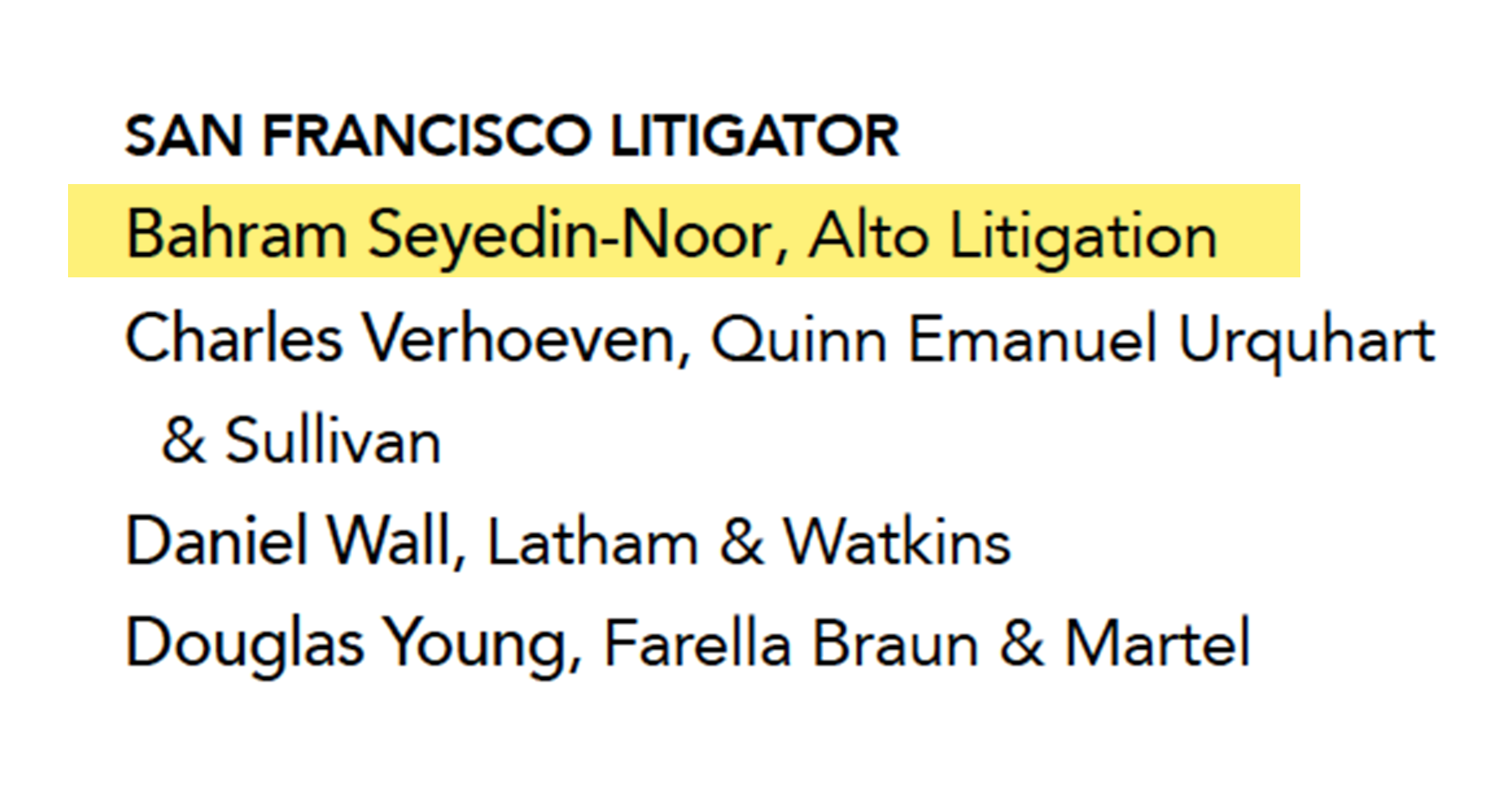
Alto Litigation is thrilled to announce that Founder and CEO Bahram Seyedin-Noor has received recognition in the 2022 edition of Chambers USA. Chambers notes that Bahram is “held in high esteem for his securities litigation practice and frequently acts for businesses and executives in defending class actions, handling M&A litigation and representing clients before the SEC.” Bahram’s ranking is among all securities litigators in California.

Chambers and Partners’ annual rankings are a well-respected publication that recognizes firms and lawyers for excellence in their chosen practice areas. Chambers rankings are thoroughly vetted by hundreds of researcher analysis, and includes interviews of thousands of lawyers and clients each year. Individuals and firms demonstrate sustained excellence to be considered for the publication. This is the second consecutive year Chambers has recognized Bahram for his practice in securities litigation.

Responding to the recognition, Bahram stated “Litigation is a team sport. I am grateful to be surrounded by the most outstanding legal team I have ever worked with. This recognition is as much for their work as it is for my contribution to our client successes.”

Bahram Seyedin-Noor and Alto Litigation nominated for 2022 Benchmark Litigation Awards

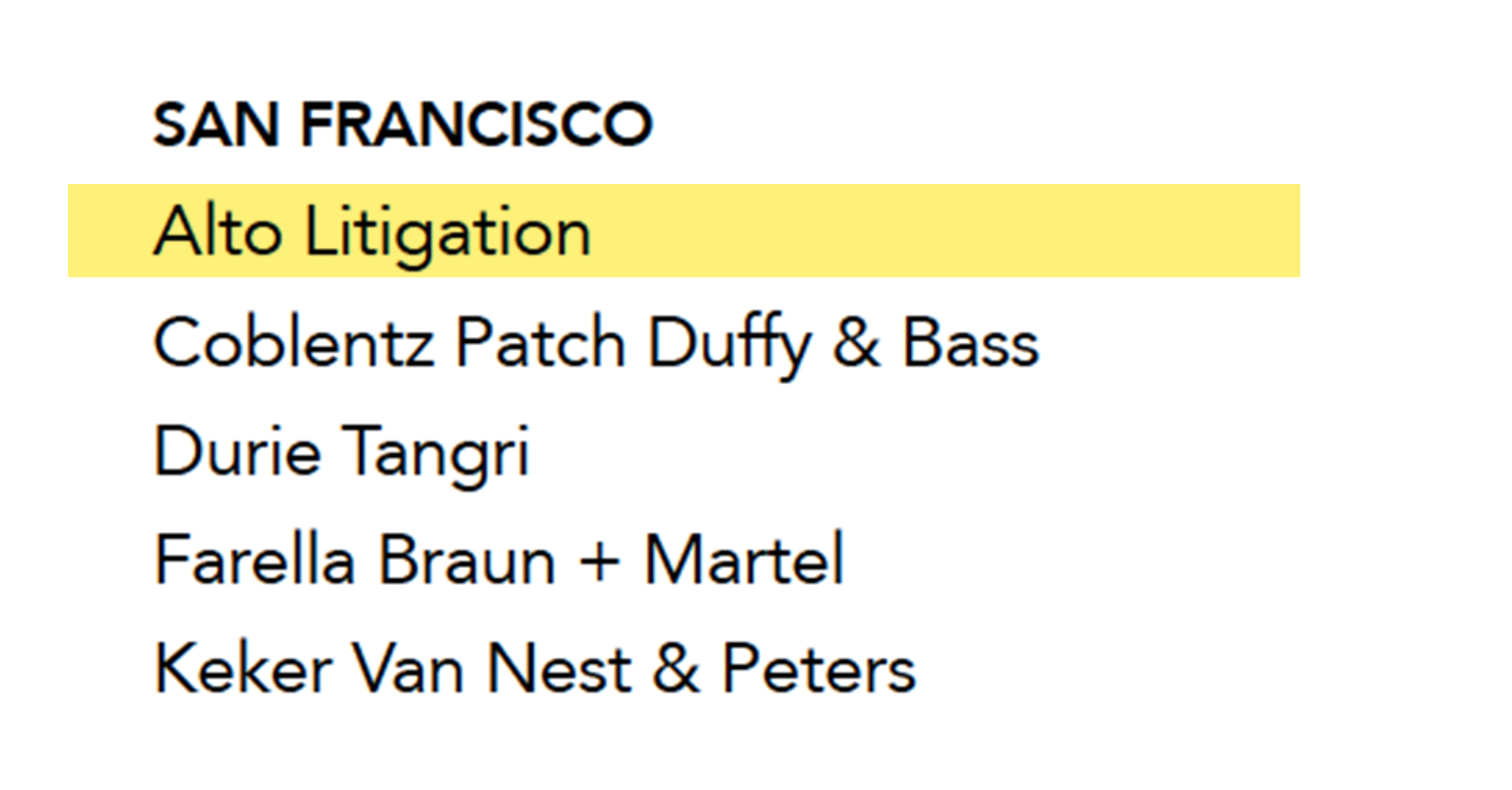
San Francisco, CA. – March 14th, 2022 – Alto Litigation is pleased to announce that Benchmark Litigation has shortlisted founder Bahram Seyedin-Noor as Benchmark’s San Francisco Litigator of the Year. This is the third time in the past four years that Benchmark Litigation has nominated Bahram for the honor, having previously selected him as San Francisco Litigator of the Year in 2019 and 2021.

In addition to Bahram’s individual honor, Alto Litigation has also been shortlisted for the Practice Area Awards - specifically for West Coast Securities Litigation and White Collar Crime/Investigations.

Benchmark Litigation exclusively covers the litigation and disputes market in North America and is described as the definitive guide to America’s leading litigation firms and attorneys. Nominees are chosen based upon extensive research conducted by Benchmark Litigation.

Benchmark Litigation will host the annual U.S. West Coast awards ceremony in person April 7, 2022 in San Francisco, CA. A full list of nominees can be found here

Bahram, a graduate of Harvard Law School, has tried cases before judges and juries in California and Delaware, and was a law clerk to Judge James Ware in the U.S. District Court for the Northern District of California. Bahram represents clients in a variety of matters, including securities class actions and derivative lawsuits, SEC investigations, trade secret disputes and complex commercial litigation.  

ABOUT ALTO LITIGATION

Headquartered in San Francisco, Alto Litigation is a leader in representing technology companies, executives, entrepreneurs, and investors in high-stakes litigation. The firm focuses on securities litigation (class actions, derivative, SEC, FINRA), intellectual property litigation (trade secrets, trademark, copyright) and other complex business disputes. Alto’s award-winning attorneys also provide pre-litigation counseling service and advice on internal investigations.

Kevin O'Brien Joins Alto Litigation As Of Counsel

San Francisco, CA. – March 10th, 2022 — Alto Litigation is pleased to announce that Kevin O’Brien has joined the firm as Of Counsel.

Kevin has successfully represented clients in a wide range of complex commercial matters, including intellectual property litigation, antitrust, unfair competition, and complex commercial disputes.

“We are thrilled to have Kevin join us at Alto Litigation,” stated firm CEO Bahram Seyedin-Noor. “Kevin is a trial-tested litigator who has worked across a wide variety of industries, ranging from biotech to semiconductors. He brings a breadth and depth of experience to the firm that will help continue to propel Alto forward in the coming years.”

Before joining Alto Litigation, Kevin was Counsel at WilmerHale LLP in Palo Alto. He also served as a law clerk to the Honorable Richard G. Andrews of the United States District Court for the District of Delaware.

ABOUT ALTO LITIGATION

Headquartered in San Francisco, Alto Litigation is a leader in representing technology companies, executives, entrepreneurs, and investors in high-stakes litigation. The firm focuses on securities litigation (class actions, derivative, SEC, FINRA), intellectual property litigation (trade secrets, trademark, copyright) and other complex business disputes. Alto’s award-winning attorneys also provide pre-litigation counseling service and advice on internal investigations.

Benchmark Podcast Interviews Alto Founder, Bahram Seyedin-Noor

San Francisco, California - November 29, 2021 - Bahram Seyedin-Noor, founder of Alto Litigation, recently appeared as a guest on Benchmark Litigation’s podcast series “Benchmark Litigation Awards.” This series showcases the Benchmark team interviewing leaders from winning firms and litigators for in-depth discussions on trial victories, case strategies, and best practices.

Bahram and Benchmark Litigation managing editor Michael Rafalowich discussed how the merging of technology, a willingness to do things differently, and big-firm expertise have combined for success at Alto. The discussion raises questions about what tools and techniques firms could be adopting to be more agile, accountable, and in-tune with their employees.

The full episode can be listened to here.

Bahram, a graduate of Harvard Law School, has tried cases before judges and juries in California and Delaware, and was a law clerk to Judge James Ware in the U.S. District Court for the Northern District of California. Bahram represents clients in a variety of matters, including securities class actions and derivative lawsuits, SEC investigations, trade secret disputes and complex commercial litigation. 

Disclaimer:

Materials on this website are for informational purposes only and do not constitute legal advice. Transmission of materials and information on this website is not intended to create, and their receipt does not constitute, an attorney-client relationship. Although you may send us email or call us, we cannot represent you until we have determined that doing so will not create a conflict of interests. Accordingly, if you choose to communicate with us in connection with a matter in which we do not already represent you, you should not send us confidential or sensitive information, because such communication will not be treated as privileged or confidential. We can only serve as your attorney if both you and we agree, in writing, that we will do so.

The materials on this website are not intended to constitute advertising or solicitation. However, portions of this website may be considered attorney advertising in some states.

Unless otherwise specified, the attorneys listed on this website are admitted to practice in the State of California.

Alto Litigation Strengthens eDiscovery Capabilities with the Addition of Derek Deavenport

Derek_Annoucement.jpg

San Francisco, Ca. (Oct. 26, 2021) - Alto Litigation is pleased to announce that Derek Deavenport has joined the firm as an attorney specializing in electronic discovery project management.

In his role, Derek will be responsible for managing the firm’s eDiscovery projects.

Derek has more than a decade of experience assisting top law firms and companies with managing large and complex eDiscovery workloads in San Francisco.

Before joining Alto, Derek worked with law firms in extracting and managing electronic information in cases involving cutting-edge technology, high finance, antitrust and government investigations.

Derek also served as a judicial extern to the Honorable Peter Busch and the Honorable Patrick Mahoney in the Law & Motion Department of the San Francisco Superior Court.

Derek earned his law degree from the University of California, Hastings College of Law.

About Alto Litigation

Headquartered in San Francisco, Alto Litigation is a leader in representing technology companies, executives, entrepreneurs and investors in high-stakes litigation. The firm focuses on securities litigation (class actions, derivative, SEC, FINRA), intellectual property litigation (trade secrets, trademark, copyright) and other complex business disputes. Alto’s award-winning attorneys also provide pre-litigation counseling service and advise on internal investigations.