Bahram Seyedin-Noor is Once Again Ranked by Chambers and Partners

Alto Litigation Founder and CEO Bahram Seyedin-Noor has been recognized in the 2023 edition of Chambers USA, the third straight year he has been included in the rankings for his practice in securities litigation in California. 

Chambers and Partners’ annual rankings are a well-respected publication that recognizes firms and lawyers for excellence in their chosen practice areas. Chambers rankings are thoroughly vetted by hundreds of researchers, whose analysis includes interviews of thousands of lawyers and clients each year. Individuals and firms must demonstrate sustained excellence to be considered for the publication. 

Among the feedback provided in support of Bahram’s recognition is that, “He is the right mix of legal grounding, commercial awareness and assertiveness.” It was also noted that, “Bahram is extremely professional, knowledgeable and offers excellent advice.”

Responding to the recognition, Bahram stated “Litigation is a team sport. I am grateful to be surrounded by such a talented and dedicated legal team. This recognition is as much for their work as it is for my contribution to our client successes.”

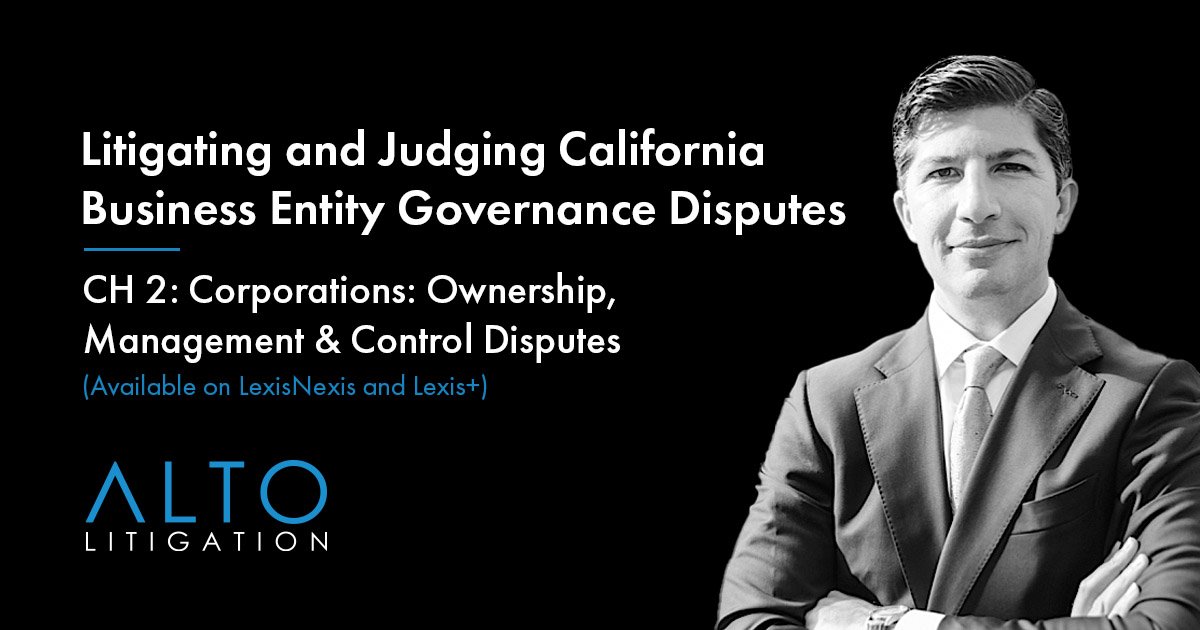
Alto Partner Bahram Seyedin-Noor Contributes to New Edition of “Litigating and Judging California Business Entity Governance Disputes”

As the nature of business evolves, so does the law pertaining to business entity governance disputes. This week, LexisNexis released the latest edition of “Litigating and Judging California Business Entity Governance Disputes” – a seminal treatise that guides practitioners through a variety of complex business matters involving management, ownership and control of California corporations, LLCs, and general and limited partnerships.

Alto Litigation’s Bahram Seyedin-Noor is the author of Chapter 2 of “Litigating and Judging California Business Entity Governance Disputes,” covering disputes between and among a corporation’s shareholders and its managers relating to the management of the corporation itself.  Alto partners Bryan Ketroser and Josh Korr also contributed to the chapter which provides relevant citations to statutes and court decisions, together with insights, helpful tips and creative solutions for arbitrators, attorneys and judges, who are dealing with disputes regarding the management of a corporation. 

Bahram Seyedin-Noor is the Founder and Managing Partner of Alto Litigation. He is a graduate of Harvard Law School and is admitted to practice in California before all federal district courts and the Ninth Circuit Court of Appeals. He is a noted litigator in complex civil litigation, business litigation and counseling, SEC enforcement matters, and private securities. He is regularly recognized for his thoughtful strategy and adept litigation skills by The California Daily Journal, Benchmark Litigation, and Chambers USA. 

For more information and to purchase the new edition visit LexisNexis.

Retirement Accounts and Personal Liability in California

For lawyers who defend corporate directors and officers against breach of fiduciary duty or fraud claims, the specter of a client’s personal liability may loom large.  Insurance may not cover liability for a breach of fiduciary duty claim (often an intentional tort), and bankruptcy protection similarly may not apply.  Nonetheless, some solace may be found in California’s forgiving debtor exemption laws: judgment creditors are barred from reaching qualified retirement accounts.

These retirement account protections are grounded in California Code of Civil Procedure section 704.115.  The statute can fully exempt ERISA retirement assets from judgement creditors, regardless of the nature of the liability.  McMullen v. Haycock, 147 Cal. App. 4th 753, 755, (2007).  So long as the judgment debtor proves an actual intention to use the ERISA account for retirement purposes, the law will exempt the account from creditor reach.  O'Brien v. AMBS Diagnostics, LLC, 38 Cal. App. 5th 553, 561, (2019).  If, however, the debtor has shown an intention inconsistent with using the ERISA account for retirement purposes—for example, using some of the funds to finance a home long before retirement—then the exemption may be lost.  

Funds held in individual retirement accounts (“IRA”) also enjoy some, albeit lesser, protection.  McMullen, 147 Cal. App. at 755.  For IRA accounts, the protection extends “only to the extent necessary to provide for the support of the judgment debtor.”  To determine the extent of the exemption, the Court will examine how much is needed to satisfy the debtor’s “common necessaries of life” based on his or her personal financial situation.  J. J. MacIntyre Co. v. Duren, 118 Cal. App. 3d Supp. 16, 18, 173 Cal. Rptr. 715, 716 (App. Dep't Super Ct. 1981).  Recreation, music lessons, and insurance expenses may justify exemption in the appropriate context.  Importantly, the debtor may use tracing to claim the exemption over eligible ERISA funds transferred to another account type.  McMullen, 147 Cal. App. at 758.

What happens when an account holder rolls ERISA assets into an IRA account that otherwise would receive only limited protection?  Does the original source of the ERISA funds control to give full protection, or does the IRA roll-over destroy the fully-exempt status?

The caselaw is split on this issue.  The more debtor-friendly cases hold that the rolled-over funds should retain their former, fully-exempt status.  McMullen, 147 Cal. App. at 755.  In McMullen itself, the debtor claimed a full exemption over funds in his IRA account, which he had rolled over from his fully-exempt ERISA retirement plan.  No other assets were added to the rollover IRA.  Opposing the full exemption, the creditor argued that the IRA rollover extinguished the full exemption as IRAs are only partially exempt under the statute’s express language.  

Agreeing with the debtor, McMullen held that full exemption should apply.  In doing so, McMullen relied on Section 703.080, which expressly allows tracing of exempt funds that are distributed to deposit accounts or in the form of cash or its equivalent.  McMullen also noted California’s policy that exemption statutes should be construed (as far as practicable) to the judgment creditor’s benefit.  The liberal tracing application honored the policy goal of allowing a debtor to best protect his or her assets.  

McMullen expressly disagreed with a California bankruptcy court that came to the opposite conclusion.  In re Mooney held that an IRA rollover should extinguish the fully-exempt status.  248 B.R. 391, 397 (Bankr. C.D. Cal. 2000).  While the Mooney court did not dispute that tracing is sometimes appropriate, it used the express statutory language giving IRA accounts only partial protection to override the tracing allowance.  Noting that the legislature never expressly stated an intention to treat rolled-over IRAs different from other IRAs, the Mooney court refused to infer such an intention either.  The Mooney court also noted that pre-retirement access to an IRA is generally easier than for an ERISA employer-sponsored plan.  The Court thus declined to give the rolled-over IRA complete exemption from the judgment creditor.    

In the years since McMullen and Mooney were decided, a third opinion has agreed with McMullenO'Brien v. AMBS Diagnostics LLC, 38 Cal. App. 5th 553, 564, 251 Cal. Rptr. 3d 41, 49 (2019) (holding that Mooney was wrongfully decided and agreeing with McMullen that no policy reason existed to extinguish the full exemption simply because the assets are deposited in an IRA rather than “a safe deposit box” or “under a mattress.”).  

Defendants confronted with an adverse judgment that may push them into bankruptcy can take solace in the fact that these protections apply even if the claims include fraud and other torts otherwise not dischargeable in bankruptcy.  See In re Phillips, 206 B.R. 196, 203 (Bankr. N.D. Cal. 1997), as corrected (Mar. 17, 1997), aff'd, 218 B.R. 520 (N.D. Cal. 1998).  Clients and practitioners alike who face (or assert) fiduciary duty claims can benefit from being familiar with the foregoing rules and exceptions.

For more information regarding Alto Litigation’s litigation practice, please contact one of Alto Litigation’s partners: Bahram Seyedin-Noor, Bryan Ketroser, or Joshua Korr.

****

Disclaimer: Materials on this website are for informational purposes only and do not constitute legal advice. Transmission of materials and information on this website is not intended to create, and their receipt does not constitute, an attorney-client relationship. Although you may send us email or call us, we cannot represent you until we have determined that doing so will not create a conflict of interests. Accordingly, if you choose to communicate with us in connection with a matter in which we do not already represent you, you should not send us confidential or sensitive information, because such communication will not be treated as privileged or confidential. We can only serve as your attorney if both you and we agree, in writing, that we will do so.

The materials on this website are not intended to constitute advertising or solicitation. However, portions of this website may be considered attorney advertising in some states.

Unless otherwise specified, the attorneys listed on this website are admitted to practice in the State of California.

Delaware Choice-of-Law: Panacea or Puzzle?

Delaware law enjoys a well-earned reputation for certainty and predictability.  This reputation leads many contracting parties to choose Delaware law as governing should a dispute arise.  But interpreting these choice-of-law provisions often gives rise to tricky legal questions.  Does the choice-of-law provision only encompass contract claims, or does it cover tort claims as well?  How does the language of the provision affect the analysis?  And what happens when Delaware law conflicts with another state’s strong public policy?  Ironically, Delaware courts themselves often disagree on the answers to these fundamental questions, injecting the very type of uncertainty into the litigation that the parties sought to avoid by selecting the law of the “First State.” 

A common threshold question is whether a contract’s choice-of-law provision encompasses tort claims or just contract claims.  The seminal case of Abry Partners V, L.P. v. F & W Acquisition LLC, 891 A.2d 1032, 1048 (Del. Ch. 2006) (J. Strine) holds that choice-of-law provisions generally do encompass tort claims, at least where the tort implicates the contract itself, e.g., fraud or misrepresentation.  In so ruling, the Abry court declined to consider the breadth or narrowness of the provision.  Instead, the court endorsed a strong preference for applying a single body of law to a dispute, in the name of business certainty:

Parties operating in interstate and international commerce seek, by a choice of law provision, certainty as to the rules that govern their relationship. To hold that their choice is only effective as to the determination of contract claims, but not as to tort claims seeking to rescind the contract on grounds of misrepresentation, would create uncertainty of precisely the kind that the parties’ choice of law provision sought to avoid. 

Not all Delaware courts have agreed with the Abry court’s decision to look past the choice-of-law provision’s language in the name of certainty.  Some have drilled down on choice-of-law language in deciding whether tort claims should fall within such a clause’s scope.  For example, Delaware courts have sometimes drawn a distinction between provisions that simply govern the “agreement” on the one hand, and provisions that govern all claims “arising out of” or “relating to” the contract on the other hand.  In Huffington v. T.C. Group, LLC, the Delaware Superior Court found that a “choice of law provision, without language such as ‘arising out of or relates to,’ only requires the Court to apply Delaware law to claims challenging the terms and provisions of the agreement.”  2012 WL 1415930 at *1 (Del. Super.).   Similarly, Gloucester Holding Corp. v. U.S. Tape and Sticky Prods., LLC, found that a provision that “[did] not claim to cover litigation that arises out of or relates to the Asset Purchase Agreement” was “not sufficiently broad enough to cover tort claims such as fraud in the inducement.”  832 A.2d 116 (Del. Ch. 2003).  

Even where a choice of law provision encompasses some torts, Delaware courts may disagree on which torts it encompasses.  For example, one recent decision held that the Delaware choice-of-law provision allows only Delaware securities fraud claims, while barring securities law claims based on the laws of other states.  Anschutz Corp. v. Brown Robin Cap., LLC, No. CV 2019-0710-JRS, 2020 WL 3096744, at *7 (Del. Ch. June 11, 2020) (dismissing Colorado and Texas securities law claims).  In contrast, another case refused to dismiss sister-state securities law claims, noting that a Delaware choice of law provision is not “a mechanism for the wholesale importation of every provision of Delaware statutory law into the commercial relationship of contracting parties.” Wind Point Partners VII-A, L.P. v. Insight Equity A.P. X Co., LLC, No. CV-19C08260, 2020 WL 5054791, at *21 (Del. Super. Ct. Aug. 17, 2020).

Delaware courts may be particularly reluctant to apply a Delaware choice-of-law provision in a way that would frustrate another state’s strong public policy.   For example, the Court of Chancery in Swipe Acquisition Corp. v. Krauss refused to apply a Delaware choice-of-law provision to bar California “blue sky” protections, which offered more expansive protections than Delaware law.  No. CV 2019-0509-PAF, 2021 WL 282642, at *3 (Del. Ch. Jan. 28, 2021).  In doing so, the Court of Chancery relied on California’s strong public policy in applying the protections to the California-based transaction, involving both a California plaintiff and misrepresentations made in California.

Our takeaway from these cases is that a Delaware choice-of-law provision may not always offer the contracting parties the litigation certainty that they hope to achieve.  To lessen the chance of unbargained-for legal risk from other jurisdictions, parties would be wise to make any Delaware choice-of-law provision as concrete as possible.  This may include drafting the contract with the specific examples of the claim types (e.g., contract, fraud, securities, business torts, etc.) that Delaware law should control.  And parties should be aware that, even with the perfect Delaware choice-of-law provision, Delaware courts may decline to bar statutory protections that the laws of other states deem essential. 

For more information regarding Alto Litigation’s litigation practice, please contact one of Alto Litigation’s partners: Bahram Seyedin-Noor, Bryan Ketroser, or Joshua Korr.

****

Disclaimer: Materials on this website are for informational purposes only and do not constitute legal advice. Transmission of materials and information on this website is not intended to create, and their receipt does not constitute, an attorney-client relationship. Although you may send us email or call us, we cannot represent you until we have determined that doing so will not create a conflict of interests. Accordingly, if you choose to communicate with us in connection with a matter in which we do not already represent you, you should not send us confidential or sensitive information, because such communication will not be treated as privileged or confidential. We can only serve as your attorney if both you and we agree, in writing, that we will do so.

The materials on this website are not intended to constitute advertising or solicitation. However, portions of this website may be considered attorney advertising in some states.

Unless otherwise specified, the attorneys listed on this website are admitted to practice in the State of California.

Drawing the Line Between Harmless Puffing and Securities Fraud

There is sometimes a fine line between the Silicon Valley entrepreneur who “fakes it till they make it” by engaging in fraud, and the disruptive visionary taking on the established order with unwavering optimism.  Legally speaking, one of the fault lines separating the two is the difference between garden-variety optimism that no reasonable person would use to guide an investment—often called “puffery” in applicable case law – and knowingly false statements. But when do rosy statements cross the line from immaterial puffery to actionable securities fraud under the law?  

In the Ninth Circuit, staying onsides between “puffing” and “fraud” involves “expressing an opinion” that is not “capable of objective verification.”  Macomb Cnty. Employees' Ret. Sys. v. Align Tech., Inc., 39 F.4th 1092, 1097–99 (9th Cir. 2022).  Non-actionable puffery is usually found based on vague statements of optimism such as “good,” “well-regarded,” or other “feel good monikers;” professional (and often amateur) investors know how to devalue the optimism of corporate executives.  But when even generalized optimism overreaches by contradicting known facts, they may ripen from puffery to fraud.  

Two recent Ninth Circuit decisions stake out helpful guideposts.  The first case is Macomb County, where the Ninth Circuit agreed that misstatements about the growth potential in the Chinese market were non-actionable puffery.  Macomb County.  39 F.4th 1092, 1099 (9th Cir. 2022).  There, the defendant was accused of securities fraud for wrongly describing China as “a great growth market,” “a huge market opportunity,” “a market that’s growing significantly for us,” and possessing “really good” “dynamics,” and describing its performance as “tremendous” and “great.”  Since these characterizations were not “objectively verifiable,” the Ninth Circuit held that they were not the “kind of precise information on which investors rely when valuing corporations.”  Significantly, the company’s sales were still growing in China (albeit at a diminished rate), so the descriptions did not “affirmatively create an impression of a state of affairs that differed in a material way from the one that actually existed.”  

But our second case shows that even “general statements of optimism, when taken in context, may form a basis for a securities fraud claim.”  Glazer Cap. Mgmt., L.P. v. Forescout Techs., Inc., --- F.4th ----, 2023 WL 2532061 (9th Cir. 2023).   In Glazer Capital Management, a cybersecurity firm allegedly made false statements in response to sensitive questions about sales performance on an earnings call.  In particular, the cybersecurity firm said that (1) its sales representative numbers were “tracking very well against our sales productivity”; and (2) it had “a very large pipeline” of potential deals that would likely close by the end of the year.  While these statements may have been general, they contradicted the allegedly true facts that (1) the number of experienced sales representatives was shrinking below acceptable levels; and (2) the company pressured sales representatives to inflate the number of deals in the pipeline that were likely to close. The context of these statements also mattered: they were made on earning calls in response to specific questions by financial analysis about disappointing financial results.  These contradictions elevated the statements from harmless puffery to actionable fraud.

Illustrating that even federal judges may differ in distinguishing between securities fraud and puffery, Glazer Capital includes a dissenting opinion.  Disagreeing that the alleged puffery amounted to fraud, the dissenting judge saw the Complaint as rather reflecting “business judgments and opinions about the timing of deals and the underlying causes of missing second quarter forecasts.”  Id. at 25.  The complaint only “reflect[ed] a difference of opinion between the [witnesses] and upper management as to when to characterize a deal as a ‘tech win’ or ‘committed,’ and how much time to allot to closing such deals when including them in earnings forecasts.”  Id.  

One final lesson to take from both Macomb and Glazer Capital is that courts considering the puffery defense do not analyze the alleged statements in a vacuum.  Regardless of how anodyne a statement may seem on its face, courts may turn to the objective truth or falsity of the statement as framed in the complaint when dismissing or upholding the securities fraud claims.  This should put management notice to take extreme care when communicating with investors about business performance and other objectively verifiable metrics. 

For more information regarding Alto Litigation’s litigation practice, please contact one of Alto Litigation’s partners: Bahram Seyedin-Noor, Bryan Ketroser, or Joshua Korr.

****

Disclaimer: Materials on this website are for informational purposes only and do not constitute legal advice. Transmission of materials and information on this website is not intended to create, and their receipt does not constitute, an attorney-client relationship. Although you may send us email or call us, we cannot represent you until we have determined that doing so will not create a conflict of interests. Accordingly, if you choose to communicate with us in connection with a matter in which we do not already represent you, you should not send us confidential or sensitive information, because such communication will not be treated as privileged or confidential. We can only serve as your attorney if both you and we agree, in writing, that we will do so.

The materials on this website are not intended to constitute advertising or solicitation. However, portions of this website may be considered attorney advertising in some states.

Unless otherwise specified, the attorneys listed on this website are admitted to practice in the State of California.

Diversity Jurisdiction for Limited Liability Corporations and Partnerships

Defendants in business disputes often wish to have their cases heard in federal rather than state court.  The Federal Rules of Civil Procedure are standardized and may be more streamlined than their state-law counterparts.  Furthermore, Plaintiffs in federal civil cases must obtain a unanimous verdict, whereas many states simply require a majority or supermajority.  There also is a prevailing perception that the federal bench is more likely to grant a defendant’s motion to dismiss or motion for summary judgment, though it is less pronounced in jurisdictions like California, which have specialized complex litigation courts that themselves are sometimes more receptive to such motions.  

Regardless of the reason for knocking, the gates of federal court are not open to all comers.  Where federal question jurisdiction is lacking, parties must navigate the corridors of diversity jurisdiction under 28 U.S.C. § 1332.  The requirements are well known; the amount in controversy must exceed $75,000 and there must be complete diversity of citizenship between all plaintiffs and defendants.  But determining whether diversity exists in cases featuring limited liability corporations and partnerships presents unique complications:  

  1. Courts Consider the Residency of All Members or Partners:   While the general rule for corporations is that they are citizens of the state in which they are incorporated, the Supreme Court has erected a “doctrinal wall,” whereby this rule does not apply to other types of entities.  See, e.g., Carden v. Arkoma Assocs., 494 U.S. 185, 189 (1990).  For unincorporated entities, diversity jurisdiction depends on the citizenship of “all the members.”  Id.  It does not matter if certain members are general or limited partners or hold greater or lesser rights.  All of their citizenships are considered.  

  2. Courts May Trace Through Multiple Entity Levels:  A court’s diversity analysis is not superficial – if one member of an LLC is itself an LLC or partnership, then the members or partners of that entity must also be considered.  See, e.g., Mut. Assignment & Indem. Co. v. Lind-Waldock & Co., LLC, 364 F.3d 858, 861 (7th Cir. 2004) (“Lind-Waldock is a limited liability company, which means that it is a citizen of every state of which any member is a citizen; this may need to be traced through multiple levels if any of its members is itself a partnership or LLC.”).

  3. Courts Split on Pleading Requirements and Jurisdictional Discovery:  A party seeking to invoke diversity jurisdiction bears the burden of pleading facts that demonstrate diversity exists.  Therefore, to properly allege diversity against an LLC or partnership, one must allege the citizenship of each of its members.  However, that information may not be publicly available, because most states do not require the identity and citizenship of partners or members of an unincorporated entity to be publicly disclosed.  This conundrum has led to divergent rulings on several related issues: 

    • Cases are currently split on whether a party invoking diversity jurisdiction may (1) allege the citizenship of an LLC or partnership based on information and belief, or (2) seek jurisdictional discovery into that issue in federal court.  See, e.g., Lincoln Ben. Life Co. v. AEI Life, LLC, 800 F.3d 99 (3d Cir. 2015) (proper to plead citizenship on information and belief and seek jurisdictional discovery); Charles Alan Wright et al., Federal Practice and Procedure: Federal Rules of Civil Procedure § 1224 (3d ed. 2013) (pleading on the basis of information and belief “is a practical necessity.”); but see, e.g., MCP Trucking, LLC v. Speedy Heavy Hauling, Inc., 2014 WL 5002116 (D. Colo. Oct. 6, 2014) (denying jurisdictional discovery and remanding to state court while noting that further discovery in state court could demonstrate that diversity exists); Lake v. Hezebicks, 2014 WL 1874853 (N.D. Ind. May 9, 2014) (collecting cases).

    • Furthermore, there is a circuit split concerning whether negative statements of citizenship, i.e. a bare allegation that the counter-party is not a citizen of the plaintiff’s state of citizenship, are sufficient.  Compare Lewis v. Rego, Co., 757 F.2d 66 (3d Cir. 1985) (negative citizenship pleading is sufficient) with D.B. Zwirn Special Opportunities Fund, LP v. Mehrotra, 661 F.3d 124 (1st Cir. 2011) (negative citizenship pleading is not sufficient).  

    • Note, some of these issues may be obviated due to recent amendments to FRCP 7.1, which now requires parties in an action in which federal court jurisdiction is based on diversity to file a disclosure statement “naming or identifying the citizenship of every individual or entity whose citizenship is attributed to that party or intervenor.”  

For more information regarding Alto Litigation’s litigation practice, please contact one of Alto Litigation’s partners: Bahram Seyedin-Noor, Bryan Ketroser, or Joshua Korr.

****

Disclaimer: Materials on this website are for informational purposes only and do not constitute legal advice. Transmission of materials and information on this website is not intended to create, and their receipt does not constitute, an attorney-client relationship. Although you may send us email or call us, we cannot represent you until we have determined that doing so will not create a conflict of interests. Accordingly, if you choose to communicate with us in connection with a matter in which we do not already represent you, you should not send us confidential or sensitive information, because such communication will not be treated as privileged or confidential. We can only serve as your attorney if both you and we agree, in writing, that we will do so.

The materials on this website are not intended to constitute advertising or solicitation. However, portions of this website may be considered attorney advertising in some states.

Unless otherwise specified, the attorneys listed on this website are admitted to practice in the State of California.

California’s Unjust Treatment of Unjust Enrichment

With ancient roots, the unjust enrichment claim has long allowed recovery for money paid by mistake or when contract formation fails.  Indeed, the Roman jurist Pomponious once dictated the operating principle behind unjust enrichment: “This by nature is equitable, that no one be made richer through another’s loss.”  John P. Dawson, Unjust Enrichment: A Comparative Analysis at 42-63 (1951).  Withstanding the test of time, unjust enrichment became enshrined in the English common law in 1760, when Lord Mansfield said, “this kind of equitable action, to recover back money, which ought not in justice to be kept, is very beneficial, and therefore much encouraged.” (1760) 2 Bur 1005.  And our legal system has largely followed suit.  As summarized by the America Law Institute, “a person who is unjustly enriched at the expense of another is subject to liability in restitution.” Restatement (Third) of Restitution and Unjust Enrichment § 1 cmt. B (2011).

Despite this august history, the unjust enrichment claim has not found eternal acceptance in California courts.  To the contrary, a recent published decision has flatly stated: “California does not recognize a cause of action for unjust enrichment.”  Hooked Media Grp., Inc. v. Apple Inc., 55 Cal. App. 5th 323, 336 (2020).  According to this strain of caselaw, the phrase “‘unjust enrichment’ does not describe a theory of recovery, but an effect: the result of a failure to make restitution under circumstances where it is equitable to do so.”  Melchior v. New Line Prods., Inc., 106 Cal. App. 4th 779, 793, 131 Cal. Rptr. 2d 347, 357 (2003).  In other words, a party may recover for unjust enrichment only if it establishes an independent—and inevitably narrower—legal claim, such as quasi-contract.  See id; Rutherford Holdings, LLC v. Plaza Del Rey, 223 Cal. App. 4th 221, 231, 166 Cal. Rptr. 3d 864, 872 (2014) (construing unjust enrichment claim as “a quasi-contract claim seeking restitution”).  Pleading unjust enrichment alone may not suffice.  Id.    

To be sure, California’s disdain for the unjust enrichment claim is not universal; some caselaw does approve of it.  For example, an unjust enrichment claim was upheld as enforceable in Elder v. Pac. Bell Tel. Co., 205 Cal. App. 4th 841, 857 (2012).  The Elder plaintiff alleged that telephone public utilities overcharged him for unauthorized premium content charges.  Id. With the elements described simply as “receipt of a benefit and [the] unjust retention of the benefit at the expense of another,” the unjust enrichment pleading survived demurrer.  Id.  

Elder does not stand alone; a laundry list of older California precedent respects the unjust enrichment claim as a viable one.  See, e.g., Peterson v. Cellco P’ship, 164 Cal. App. 4th 1583, 1593 (2008) (stating elements of unjust enrichment); Lectrodryer v. SeoulBank, 77 Cal. App. 4th 723, 726 (2000) (“Lectrodryer satisfied the elements for a claim of unjust enrichment: receipt of a benefit and unjust retention of the benefit at the expense of another.”); Ghirardo v. Antonioli, 14 Cal. 4th 39, 50, 54 (1996) (party was entitled to “seek relief under traditional equitable principles of unjust enrichment”; claim for “payment of money” based on unjust enrichment theory was “adequately pleaded and proved”); First Nationwide Sav. v. Perry, 11 Cal. App. 4th 1657, 1662 (1992) (“[plaintiff’s] complaint can be amended to state a cause of action for unjust enrichment.”).

Despite the stubborn split of authority, the California Supreme Court has yet to weigh in on either restoring the unjust enrichment claim to its historical status or relegating it to the dustbin of history.  In the meantime, a wise plaintiff will plead at least one other theory, quasi-contract or otherwise, that is universally accepted under California law.

For more information regarding Alto Litigation’s litigation practice, please contact one of Alto Litigation’s partners: Bahram Seyedin-Noor, Bryan Ketroser, or Joshua Korr.

****

Disclaimer: Materials on this website are for informational purposes only and do not constitute legal advice. Transmission of materials and information on this website is not intended to create, and their receipt does not constitute, an attorney-client relationship. Although you may send us email or call us, we cannot represent you until we have determined that doing so will not create a conflict of interests. Accordingly, if you choose to communicate with us in connection with a matter in which we do not already represent you, you should not send us confidential or sensitive information, because such communication will not be treated as privileged or confidential. We can only serve as your attorney if both you and we agree, in writing, that we will do so.

The materials on this website are not intended to constitute advertising or solicitation. However, portions of this website may be considered attorney advertising in some states.

Unless otherwise specified, the attorneys listed on this website are admitted to practice in the State of California.

Daily Journal Publishes Jared Kopel Article on Supreme Court Case that Could Relax the Barriers to Securities Suits

The Supreme Court will soon consider whether a direct listing on an exchange eliminates the need for a claim under the Securities Act of 1933 to prove that the plaintiff bought stock issued pursuant to the registration statement that allegedly contained misrepresentations. The case, Slack Technologies, LLC v. Pirani, is significant given that the Court’s decisions could relax the barriers to private securities lawsuits against companies going public.

Jared Kopel, a senior counsel at Alto Litigation, recently wrote an article in the Daily Journal breaking down what’s at stake and the key issues the Court will be considering in the Slack Technologies case. Click here to access the article (subscription required).

For more information regarding securities litigation, please contact one of Alto Litigation’s partners Bahram Seyedin-Noor, Bryan Ketroser or Joshua Korr, or senior counsel Jared Kopel.

****

Disclaimer: Materials on this website are for informational purposes only and do not constitute legal advice. Transmission of materials and information on this website is not intended to create, and their receipt does not constitute, an attorney-client relationship. Although you may send us email or call us, we cannot represent you until we have determined that doing so will not create a conflict of interests. Accordingly, if you choose to communicate with us in connection with a matter in which we do not already represent you, you should not send us confidential or sensitive information, because such communication will not be treated as privileged or confidential. We can only serve as your attorney if both you and we agree, in writing, that we will do so.

The materials on this website are not intended to constitute advertising or solicitation. However, portions of this website may be considered attorney advertising in some states.

Unless otherwise specified, the attorneys listed on this website are admitted to practice in the State of California.

SEC’s Continued Focus on Insider Trading Plans: New Rulemaking and Enforcement Action

In the past week the SEC has demonstrated its continued focus on insider trading and Rule 10b5-1 trading plans under Chairman Gary Gensler’s watch.

First, the SEC’s December 2022 amendments to Rule 10b5-1 of the Securities Exchange Act took effect. These amendments increase the requirements on company insiders who adopt 10b5-1 trading plans in the following ways:

  • Mandatory Cooling Off Periods: The amendments require corporate officers or directors who enter into Rule 10b5-1 trading arrangements to observe a cooling-off period of up to 120 days before any trading may commence. The new amendments also mandate a cooling-off period of 30 days for trading arrangements for people other than issuers, directors or officers.

  • Good Faith Certification Re: Material Non-Public Information: Directors and managers adopting or modifying a 10b5-1 plan must now certify that they are not aware of any material nonpublic information about a company or its securities and that they are adopting the plan in good faith.

  • Prohibition on Overlapping Plans: The amendments restrict the use of multiple overlapping trading plans and limit the ability to rely on the affirmative defense for a single-trade plan to one single-trade plan per twelve-month period for all persons other than issuers.

  • Enhanced Disclosure Requirements: The amendments require more comprehensive disclosure about issuers’ policies and procedures related to insider trading, including quarterly disclosure regarding the use of Rule 10b5-1 plans; the timing of options grants and the release of material nonpublic information; and a requirement to report any option awards beginning four business days before the filing of a periodic report or a Form 8-K that discloses material nonpublic information. Furthermore, insiders that report on Forms 4 or 5 will be required to indicate that a reported transaction was intended to satisfy the affirmative defense conditions of Rule 10b5-1(c) and to disclose the date of adoption of the trading plan.

Second, the SEC announced an enforcement action for insider trading with respect to trades made pursuant to a 10b5-1 plan. The SEC brought this enforcement action against the Executive Chairman of Ontrak, a health care company based in Santa Monica, for selling more than $20 million in stock while he was aware of the company's deteriorating relationship with a major customer. The defendant, Terrence Peizer, allegedly sold his stock after he had entered into Rule 10b5-1 trading plans. The SEC alleged that Peizer entered into those plans while in possession of material nonpublic information. Parallel criminal charges also were brought against Peizer.

For more information regarding insider trading, and SEC-related issues in general, please contact one of Alto Litigation’s partners:  Bahram Seyedin-Noor, Bryan Ketroser, or Joshua Korr.

****

Disclaimer: Materials on this website are for informational purposes only and do not constitute legal advice. Transmission of materials and information on this website is not intended to create, and their receipt does not constitute, an attorney-client relationship. Although you may send us email or call us, we cannot represent you until we have determined that doing so will not create a conflict of interests. Accordingly, if you choose to communicate with us in connection with a matter in which we do not already represent you, you should not send us confidential or sensitive information, because such communication will not be treated as privileged or confidential. We can only serve as your attorney if both you and we agree, in writing, that we will do so.

The materials on this website are not intended to constitute advertising or solicitation. However, portions of this website may be considered attorney advertising in some states.

Unless otherwise specified, the attorneys listed on this website are admitted to practice in the State of California.

SEC Cracks Down On Crypto

Gary Gensler, the chair of the Securities and Exchange Commission, keeps his promises, at least when it comes to cracking down on crypto trading.  And not everyone is happy about it.

In recent weeks, the SEC has:

  • Brought charges against Hall of Famer former NBA star Paul Pierce for touting EMAX tokens, a crypto asset offered and sold by Ethereum, on social media without disclosing that he received more than $244,000 in tokens for his promotional effort. The SEC also alleged that Pierce misrepresented the size of his personal holdings of the tokens. Without admitting or denying the allegations, Pierce agreed to pay a $1.115 million penalty and make approximately $240,000 in disgorgement.

  • Accused Singapore-based Terraform Labs PTE Ltd. and its CEO and majority stockholder, Do Hyeong Kwon, of a four-year scheme that raised billions of dollars from investors by selling various crypto assets that the SEC alleged were securities in fraudulent unregistered transactions that resulted in significant losses for U.S. investors. The complaint asserted, among other things, that defendants misled investors about the stability of Terraform’s algorithmic “stablecoin,” called Terra USD (UST), that purportedly was pegged to the value of the U.S. dollar. The SEC charged that UST’s value was propped only by billions of dollars from investors, and then that after cash disappeared, the value of UST and Terraform’s other crypto assets fell to zero.

  • Charged Payward Ventures, Inc. and Payward Trading Ltd., both commonly known as Kraken, with failing to register the offer and sale of their crypto asset staking-as-a-service program, whereby Kraken pooled crypto assets provided by investors and stakes them on behalf of investors. Staking involves locking up tokens in exchange for new tokens when the staked crypto becomes part of the process for validating data on a blockchain.  The SEC’s complaint filed in federal court in San Francisco alleged that although Kraken promised 21% annual investment returns, investors did not receive necessary disclosure, including disclosures surrounding the business and financial condition of defendants, fees, and the risk that investors might lose protection of their tokens.  The Kraken entities settled by agreeing to shut down the staking program and pay $30 million in disgorgement, prejudgment interest and penalties.  However, SEC Commissioner Hester Peirce, a longtime defender of crypto, objected to the enforcement action, arguing that staking services provide a benefit to investors.

  • Charged Genesis Global Capital and Gemini Trust Company (controlled by the Winkelvoss Brothers) with the unregistered offer and sale of securities through the Gemini Earn crypto asset lending program.

  • Brought settled charges against Nexo Capital, Inc. for failing to register the offer and sale of its retail crypto asset lending product, Earn Interest Product (EIP). Nexo agreed to halt the sale of EIP and pay a $22.5 million penalty, as well as pay an identical amount to settle state regulatory actions.

  • Voted 4-1 to amend federal custody requirements to include crypto assets, which would likely require crypto exchanges to obtain further regulatory approval. Commissioner Peirce again objected, opposing the rule because of its timing, workability and breadth.  But she also stated that she hoped to support a final rule after public comment and possible amendments. Commissioner Peirce was not alone in her criticism. The chief policy officer of the Blockchain Association, an industry group, accused the SEC of engaging in “regulation by enforcement.” And Coinbase’s CEO, Brian Armstrong, accused the SEC of “sketchy behavior” while Tyler Winkelvoss called the SEC’s charges against Genesis and Gemini as “totally counterproductive.” 

For more information regarding strategy involving interactions with the SEC, please contact one of Alto Litigation’s partners:  Bahram Seyedin-Noor, Bryan Ketroser, or Joshua Korr.

****

Disclaimer: Materials on this website are for informational purposes only and do not constitute legal advice. Transmission of materials and information on this website is not intended to create, and their receipt does not constitute, an attorney-client relationship. Although you may send us email or call us, we cannot represent you until we have determined that doing so will not create a conflict of interests. Accordingly, if you choose to communicate with us in connection with a matter in which we do not already represent you, you should not send us confidential or sensitive information, because such communication will not be treated as privileged or confidential. We can only serve as your attorney if both you and we agree, in writing, that we will do so.

The materials on this website are not intended to constitute advertising or solicitation. However, portions of this website may be considered attorney advertising in some states.

Unless otherwise specified, the attorneys listed on this website are admitted to practice in the State of California.

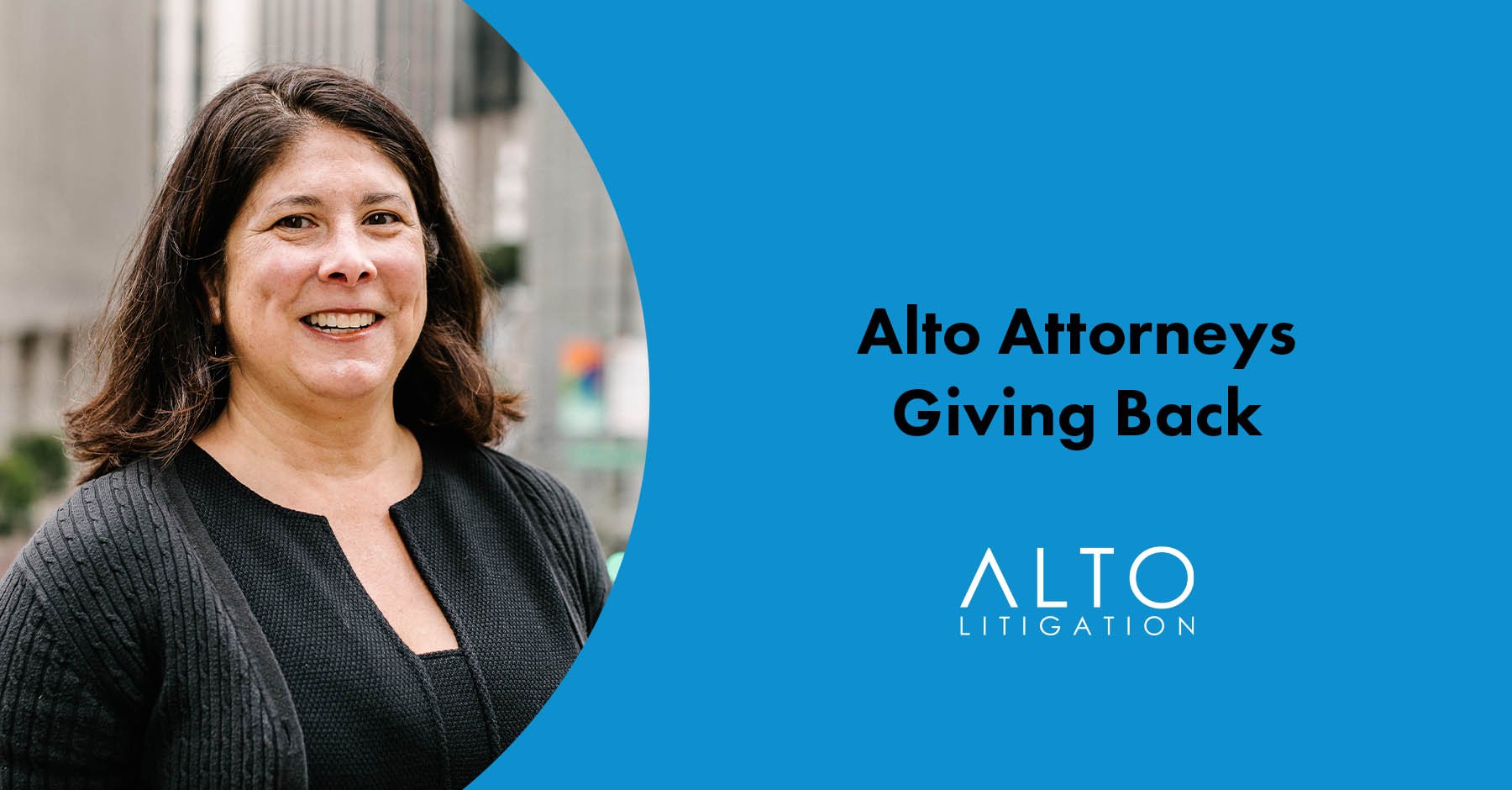
Alto Litigation Attorneys Giving Back

Serving our community through pro bono work is part of Alto Litigation’s core values. In this season of giving, we are even more grateful for the opportunities to give back to the local community. 

In 2022, Alto attorney Monica Mucchetti Eno took on a pro bono engagement for a client of the Legal Aid Society of San Mateo. The Legal Aid Society is a vital voice for underserved populations that provides free, quality legal services to low-income residents in San Mateo County.

Legal Aid Society of San Mateo provides a myriad of legal services including domestic violence support, guardianship, housing clinics, conservatorship, and other needs as they arise. In her pro bono work, Ms. Eno represented the mother of an 18-year-old child with severe developmental and cognitive disabilities, to secure conservatorship over her son. 

As a result of Ms. Eno’s efforts, the client obtained a Court Order in August appointing her as her son’s limited conservator. As her son’s conservator, the client may now provide for her son’s needs associated with daily life, including making arrangements for his housing, health care, meals, personal care and education.

Five Reasons to Designate your Case as Complex in California Superior Court

Litigation is rarely simple, but there are complex cases, and then there are “complex cases.”  

A “complex case” is an action that requires exceptional judicial management to avoid placing unnecessary burdens on the Court or the litigants. The designation is intended to expedite the case, keep costs reasonable, and promote effective decision-making by the court, the parties, and counsel. California Rule of Court 3.400(b) sets forth five criteria for the court to consider in determining whether a case should be treated as complex. Those criteria are whether the action is likely to involve:

  1. Numerous pretrial motions raising difficult or novel legal issues that will be time-consuming to resolve;

  2. Management of a large number of witnesses or a substantial amount of documentary evidence;

  3. Management of a large number of separately represented parties;

  4. Coordination with related actions pending in one or more courts in other counties, states, or countries, or in a federal court; or

  5. Substantial post-judgment judicial supervision

While the court has the final say in whether a given case qualifies as complex, it likely will not undertake such an analysis unless prompted by one or both parties through a complex case designation (or counter-designation). 

Here are five reasons why you may want to consider designating your case as complex:

(1) Complex Cases are Assigned to Individual Judges

Unlike the typical case filed in California Superior Court, which may pass through multiple judicial hands, a complex case is assigned to the same judge for the entire life of the proceeding.  This will lead to a more educated judge, which in turn leads to better case management. 

This may be particularly important in a complicated securities or trade secrets dispute, where the Court’s ability to internalize new and unfamiliar fact patterns may prove essential to effective case management—and even resolution on the merits. With a single presiding judge, the parties will also benefit from tailoring their arguments to that judge’s preferences and past rulings, as expressed in both the current and past cases. 

Finally, complex case departments generally have a small number of complex judges. Indeed, San Francisco Superior Court has only two judges within the complex case department; Santa Clara Superior Court has only one judge. With this known universe of highly respected judicial officers, a party may readily predict which judicial officer will oversee its case before filing suit, leading to more predictable outcomes.  

(2) A Case Management Schedule Tailored to Your Client’s Needs.  

In a complex matter, a judge may depart from the California Rules of Court relating to pleadings, demurrers, ex parte applications, motions, discovery, provisional remedies, and the format of filings. Volkswagen of America, Inc. v. Super. Ct. 94 Cal. App. 4th 695, 704-05 (2001). 

This gives both the Court and the parties leeway to fashion a case schedule tailored to the needs of the case that are not necessarily called for by the default California rules. For example, parties often find it beneficial to include serial deadlines for completing document production, final interrogatory responses, fact depositions, requests for admissions, expert disclosures, expert depositions, dispositive motions, and the pre-trial order.  

A complex designation empowers the Court with the flexibility to impose and adjust these and other discovery deadlines as needed within the scheduling order to ensure an orderly resolution of the case.     

(3) Flexible Discovery Procedures

Many litigants also appreciate the more flexible discovery procedures typically offered in the complex setting. For example, the San Francisco Superior Court’s Complex Department automatically stays the deadline to file a motion to compel, normally required within 45 days of receiving a discovery response.  

This does away with the tedious practice of requiring the parties to stipulate to any such extensions, often inevitable in cases with voluminous document productions that neither side can realistically complete within the 45-day window.  

Complex courts also routinely adopt more informal mechanisms to resolve discovery (and sometimes non-discovery) disputes in lieu of formal motion practice.  

The San Francisco Complex Department offers another choice example. Eschewing formal motion practice, the parties are instructed to contact the Court to schedule an informal discovery conference when a dispute arises. The parties should provide a joint five-page letter outlining the nature of the discovery dispute.  

In our experience, this procedure is usually sufficient to resolve discovery disputes short of more costly and time-consuming motion practice. Given the number of discovery disputes that often arise in complex cases, we find these expedited procedures a superior alternative to resolving discovery disputes with the more burdensome formal briefing called for by the California Code of Civil Procedure.           

(4) Managing ESI Discovery

A judge assigned to a complex case is much more likely to have a solid foundation in managing discovery disputes involving large amounts of electronically-searchable information (“ESI”).  

Winning or losing your case may hinge on your ability to obtain the relevant evidence that may exist in these formats. At the same time, the sheer amount of data that may arguably be responsive to a facially reasonable discovery request may impose huge cost burdens on a responding party.  

This often becomes a fundamental pressure point in modern litigation, where the parties will need to negotiate the production of ESI from individual custodians, non-custodial resources, and instant messaging platforms.  

The parties are also often required to engage in the tedious but necessary process of iterating search terms. If a dispute arises, a steady judicial hand is essential to help the parties arrive at the correct balance between uncovering the relevant evidence while avoiding unreasonable discovery burdens.  

A complex judge is much more likely to have the required experience with the modern information technology platforms underlying these disputes.   

(5) Protective Orders

Another benefit of designating a case as complex relates to the relative ease of obtaining a robust protective order. These protective orders are often necessary in complex cases involving highly confidential information and trade secrets.  

The parties will benefit from working with an experienced jurist who is sensitive to the disclosure of confidential business matters. Many complex departments even offer model protective orders that include robust protections.  

For example, the Santa Clara County Complex Division offers a model protective order that allows for the protection of “trade secrets” and “confidential business or financial information[.]” This model protective order also includes specific procedures for filing confidential information under seal, an extremely useful standard for streamlining the sealing process that otherwise lacks clarity in the California Civil Procedure Code. 

*  *  *
Please contact Alto Litigation partners Bahram Seyedin-Noor (bahram@altolit.com) or Bryan Ketroser (bryan@altolit.com) if you require counseling on a securities litigation matter.

****

Disclaimer: Materials on this website are for informational purposes only and do not constitute legal advice. Transmission of materials and information on this website is not intended to create, and their receipt does not constitute, an attorney-client relationship. Although you may send us email or call us, we cannot represent you until we have determined that doing so will not create a conflict of interests. Accordingly, if you choose to communicate with us in connection with a matter in which we do not already represent you, you should not send us confidential or sensitive information, because such communication will not be treated as privileged or confidential. We can only serve as your attorney if both you and we agree, in writing, that we will do so.

The materials on this website are not intended to constitute advertising or solicitation. However, portions of this website may be considered attorney advertising in some states.

Unless otherwise specified, the attorneys listed on this website are admitted to practice in the State of California.


¹ https://www.scscourt.org/court_divisions/civil/complex/Model%20Confidentiality%20Order.pdf

Alto Litigation Partners Named Super Lawyers

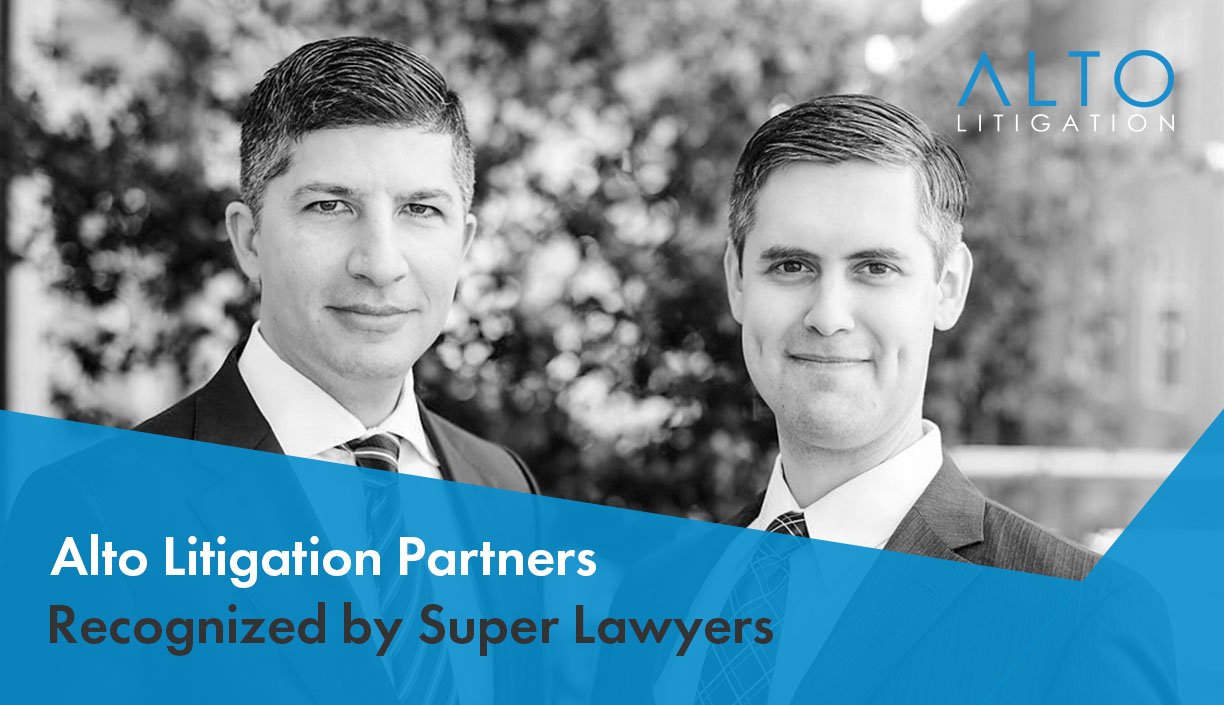
Super Lawyers, a nationwide legal rating service, has included Alto Litigation Partners Bahram Seyedin-Noor and Bryan Kertroser on its 2022 list. Bahram Seyedin-Noor was recognized for his work in securities, business, and intellectual property litigation. Bryan Ketroser was recognized in securities and business litigation.

Only the top 5% of attorneys nominated are selected to the list, which Super Lawyers says is made up of “outstanding lawyers who have attained a high-degree of peer recognition and professional achievement.” Super Lawyers utilizes a patented, peer-influenced and research-driven selection process to determine its list each year, more information on the process is available here.

Super Lawyers notes that peer recognition is based on outstanding work, knowledge of the law, work ethic, and “commitment to the spirit of the legal profession.” Their selection for the 2022 list is Bryan’s third consecutive and Bahram’s eighth consecutive inclusion. 


Morgan v Sundance Part IV: Impact on State Courts

When a party is sued and has a right to move to compel arbitration, but delays and engages in the litigation process instead, there arises the question of whether, or at what point, the defending party has waived its right to arbitration.  In May 2022, the Supreme Court issued its opinion in Morgan v. Sundance, Inc., where it held that under the Federal Arbitration Act (“FAA”), courts may not “condition a waiver of the right to arbitration on a showing of prejudice.”  Prior to Morgan, a majority of federal courts of appeal had required a showing of prejudice before finding arbitration waiver.  According to the Supreme Court that was erroneous because the federal policy “favoring arbitration” does not permit courts to “invent special, arbitration preferring procedural rules.”  Rather, it simply requires courts to place arbitration agreements “on the same footing as other contracts.”  Since “a federal court assessing waiver does not generally ask about prejudice,” the Court held it could not do so in the context of arbitration waiver either. 

As noted in Part III of Alto Litigation’s blog series on Morgan v. Sundance, courts have identified ambiguity in Morgan’s primary holding.  Specifically, it is not clear whether courts should continue to apply their unique arbitration waiver tests (shorn of any prejudice requirement) or simply apply their general test for waivers of all contractual rights.  While there often will not be “much daylight between those two tests,” the Southern District for New York concluded that in the Second Circuit at least, the two tests could lead to different results.  That conclusion led the court to perform two waiver analyses before rendering its ruling. 

But what should state courts do?  After all, Morgan was a federal holding regarding federal procedural rules.  However, because the FAA applies to lawsuits that involve interstate commerce, it preempts state laws that fail to place arbitration agreements on equal footing with other contracts.  Therefore, if state court litigation involves interstate commerce within the meaning of the FAA, then the court will have to apply Morgan.  If the litigation involves wholly intrastate issues, then Morgan will not be binding.  Thus, the first step for a state court is to evaluate whether the dispute is inter- or intra-state.  

If the dispute is truly interstate, then the state court must grapple with the impact of Morgan.  The biggest problem arises in states where prejudice is an integral component of the implied waiver analysis that applies to all contracts.  While Morgan was based on the premise that “a federal court assessing waiver does not generally ask about prejudice,” that is not true in all fifty states.  Thus, the second step, is to ascertain the jurisdiction’s test for arbitration waiver and compare it to the general test for waiver to see if there is meaningful daylight between them.  


For example, in Nevada, the test for implied waiver requires a showing of prejudice:  “In order to establish a waiver, the intention to waive must clearly appear, and the party relying upon the waiver must have been misled to his prejudice.”  If a Nevada court were to try to apply Morgan, it is faces something of a catch-22:  

  • If the court follows Morgan’s command to strip prejudice from the test, then the court would violate Morgan’s command to avoid bespoke procedural rules that treat arbitration agreements different from other agreements; 

  • If the court applies its general implied waiver rule, it would violate Morgan’s express holding that prejudice should not be part of the arbitration waiver analysis.  

While it is unclear how the ambiguity in Morgan should be resolved, it may not have much bearing on case outcomes, as explained in Part V of this blog series. 

*  *  *
Please contact Alto Litigation partners Bahram Seyedin-Noor (bahram@altolit.com) or Bryan Ketroser (bryan@altolit.com) if you require counseling on a securities litigation matter.

****

Disclaimer: Materials on this website are for informational purposes only and do not constitute legal advice. Transmission of materials and information on this website is not intended to create, and their receipt does not constitute, an attorney-client relationship. Although you may send us email or call us, we cannot represent you until we have determined that doing so will not create a conflict of interests. Accordingly, if you choose to communicate with us in connection with a matter in which we do not already represent you, you should not send us confidential or sensitive information, because such communication will not be treated as privileged or confidential. We can only serve as your attorney if both you and we agree, in writing, that we will do so.

The materials on this website are not intended to constitute advertising or solicitation. However, portions of this website may be considered attorney advertising in some states.

Unless otherwise specified, the attorneys listed on this website are admitted to practice in the State of California.


¹ Morgan v. Sundance, Inc., 142 S.Ct. 1708, 1713 (2022)

² Id.

³ Id.

Id.

Herrera v. Manna 2nd Avenue LLC, 1:20-cv-11026-GHW, 2022 WL 2819072, at *7 (July 18, 2022) (internal citations omitted).

Id.

⁷ 9 U.S.C. § 1.

Southland Corp. v. Keating, 465 U.S. 1 (1984).

Alto's Bahram Seyedin-Noor Contributes to Seminal Treatise on California Litigation

As the nature of business evolves, so does the law pertaining to business entity governance disputes. This week, LexisNexis released the latest edition of “Litigating and Judging California Business Entity Governance Disputes” – a seminal treatise that guides practitioners through a variety of complex business matters involving management, ownership and control of California corporations, LLCs, and general and limited partnerships.

Alto Litigation’s Bahram Seyedin-Noor is the author of Chapter 2 of “Litigating and Judging California Business Entity Governance Disputes,” covering disputes between and mong a corporation’s shareholders and its managers relating to the management of the corporation itself.  Alto partner Bryan Ketroser and partner-elect Joshua Korr also contributed to the chapter, which provides relevant citations to statutes and court decisions, together with insights, helpful tips and creative solutions for arbitrators, attorneys and judges, who are dealing with disputes regarding the management of a corporation.

Bahram Seyedin-Noor is the Founder and Managing Partner of Alto Litigation. He is a graduate of Harvard Law School and is admitted to practice in California before all federal district courts and the Ninth Circuit Court of Appeals. He is a noted litigator in complex civil litigation, business litigation and counseling, SEC enforcement matters, and private securities. He is regularly recognized for his thoughtful strategy and adept litigation skills by The California Daily Journal, Benchmark Litigation, and Chambers USA.

For more information and to purchase the new edition visit LexisNexis.

Morgan v Sundance Part III: How to Apply Morgan's Holding

When a party is sued and has a right to move to compel arbitration, but delays and engages in the litigation process, there arises the question of whether, or at what point, the defending party has waived its right to arbitration.  In May 2022, the Supreme Court issued its opinion in Morgan v. Sundance, Inc., where it held that under the Federal Arbitration Act (“FAA”), courts may not “condition a waiver of the right to arbitration on a showing of prejudice.”  Prior to Morgan, a majority of federal circuit courts had required a showing of prejudice before finding arbitration waiver.  According to the Supreme Court that was erroneous because the federal policy “favoring arbitration” does not permit courts to “invent special, arbitration preferring procedural rules.”  Rather, it simply requires courts to place arbitration agreements “on the same footing as other contracts.”  Since “a federal court assessing waiver does not generally ask about prejudice,” the Court held it could not do so in the context of arbitration waiver either. 

Sounds simple, but there is room for disagreement regarding how courts should interpret Morgan.  As the Southern District of New York recently recognized in Herrera v. Manna 2nd Avenue LLC:  

[T]he Supreme Court’s decision suggests that courts should toss out special rules for considering waivers of the right to arbitration, and instead use the same test for waiver as would be used in any other contractual dispute.  However, in its directions to the Eighth Circuit on remand, the Supreme Court commented that the Eighth Circuit could “strip” its test “of its prejudice requirement” and ask, “[d]id Sundance, as the rest of the Eighth Circuit’s test asks, knowingly relinquish the right to arbitrate by acting inconsistently with that right?”  That language suggests that the Eighth Circuit should merely strip analysis of prejudice from its existing test for waiver of the right to arbitrate, rather than applying the Circuit’s standard test for evaluating waiver in cases not involving arbitration agreements.

That instruction is not entirely consistent with Morgan’s instruction to adopt a general waiver analysis, as the remainder of the opinion suggests.  That is because the Eighth Circuit’s test for general waivers of contract rights differs from its test for waivers of the right to arbitrate—even when the latter is stripped of its prejudice requirement. 

The Court in Herrera then proceeded to explain that while the two tests in the Eight Circuit are fairly similar once prejudice is removed from the equation, “in the Second Circuit—which has not yet interpreted Morgan—there is a more significant (and, in some cases, possibly dispositive) difference between the two tests.”  As a result, the court proceeded to analyze the issue of arbitration waiver using both of the Second Circuit’s waiver tests.

In light of the ambiguity highlighted in Herrera, counsel litigating arbitration waiver should evaluate whether the general contractual waiver test in the jurisdiction where the dispute is pending differs from its arbitration-specific waiver test, particularly where application of the different tests might yield different results.  The issue will be most pronounced if the jurisdiction’s general implied waiver test contains a prejudice requirement, as discussed more fully in Part IV of Alto Litigation’s blog series on Morgan v. Sundance.  

*  *  *
Please contact Alto Litigation partners Bahram Seyedin-Noor (bahram@altolit.com) or Bryan Ketroser (bryan@altolit.com) if you require counseling on a securities litigation matter.

****

Disclaimer: Materials on this website are for informational purposes only and do not constitute legal advice. Transmission of materials and information on this website is not intended to create, and their receipt does not constitute, an attorney-client relationship. Although you may send us email or call us, we cannot represent you until we have determined that doing so will not create a conflict of interests. Accordingly, if you choose to communicate with us in connection with a matter in which we do not already represent you, you should not send us confidential or sensitive information, because such communication will not be treated as privileged or confidential. We can only serve as your attorney if both you and we agree, in writing, that we will do so.

The materials on this website are not intended to constitute advertising or solicitation. However, portions of this website may be considered attorney advertising in some states.

Unless otherwise specified, the attorneys listed on this website are admitted to practice in the State of California.


¹ Morgan v. Sundance, Inc., 142 S.Ct. 1708, 1713 (2022)

² Id.

³ Id.

Id.

Herrera v. Manna 2nd Avenue LLC, 1:20-cv-11026-GHW, 2022 WL 2819072, at *7 (July 18, 2022) (internal citations omitted).

Morgan v. Sundance Part II: Limitations on the Federal Policy in Favor of Arbitration

In May 2022, the Supreme Court issued its opinion in Morgan v. Sundance, Inc., where it held that under the Federal Arbitration Act (“FAA”), courts may not “condition a waiver of the right to arbitration on a showing of prejudice.”¹  Prior to Morgan, a majority of federal circuit courts had required a showing of prejudice before finding arbitration waiver.  According to the Supreme Court that was erroneous because the federal policy “favoring arbitration” does not permit courts to “invent special, arbitration preferring procedural rules.”² Rather, it simply requires courts to place arbitration agreements “on the same footing as other contracts.”³ Since “a federal court assessing waiver does not generally ask about prejudice,” the Court held it could not do so in the context of arbitration waiver either.⁴  

Morgan provides an important reminder regarding the limitations of the federal policy favoring arbitration.  According to the Court, that policy is “not about fostering arbitration,” it is about ensuring agreements to arbitrate are enforced just as any other contract would be.⁵  

“The policy,” we have explained, is merely an acknowledgment of the FAA’s commitment to overrule the judiciary’s longstanding refusal to enforce agreements to arbitrate and to place such agreements upon the same footing as other contracts.  Or in another formulation: The policy is to make arbitration agreements as enforceable as other contracts, but not more so.  Accordingly, a court must hold a party to its arbitration contract just as the court would to any other kind.  But a court may not devise novel rules to favor arbitration over litigation.  If an ordinary procedural rule—whether of waiver or forfeiture or what-have-you—would counsel against enforcement of an arbitration contract, then so be it.⁶

While earlier Supreme Court cases like Moses H. Cone Memorial Hospital v. Mercury Construction Corp. had stated otherwise in dicta,⁷ Morgan put that broader theory to rest.   

As it stands, the policy in favor of arbitration applies to questions regarding the scope of an arbitration clause, such that “any doubts concerning the scope of arbitrable issues should be resolved in favor of arbitration.”⁸ However, courts have found that the policy in favor of arbitration does not apply in the following circumstances: 

  • Who Decides Arbitrability: questions regarding who decides threshold issues of arbitrability are presumptively for courts to decide unless the parties “clearly and unmistakably provide otherwise”;⁹

  • Note: Several courts have held that parties “clearly and unmistakably” agree to delegate arbitrability questions to an arbitrator by incorporating into their arbitration agreements institutional arbitration rules that empower an arbitrator to decide gateway arbitrability issues¹⁰

  • Formation of an Agreement to Arbitrate: “the presumption does not apply to disputes concerning whether an agreement to arbitrate has been made,” which is governed by state contract law;¹¹ and

  • Standing to Invoke an Agreement to Arbitrate: questions regarding who has standing to invoke an agreement to arbitrate are likewise governed by state contract law.¹²

And, of course, Morgan holds that the policy in favor of arbitration does not allow courts to create bespoke procedural rules favoring arbitration.¹³    

In sum, counsel litigating arbitrability issues must review pre-Morgan case law with a  careful eye to determine whether that precedent provides a reliable basis to invoke the federal policy in favor of arbitration. 

For further analysis, see Parts III–V of Alto Litigation’s Morgan v. Sundance blog series.

***

Please contact Alto Litigation partners Bahram Seyedin-Noor (bahram@altolit.com) or Bryan Ketroser (bryan@altolit.com) if you require counseling on a securities litigation matter.

****

Disclaimer: Materials on this website are for informational purposes only and do not constitute legal advice. Transmission of materials and information on this website is not intended to create, and their receipt does not constitute, an attorney-client relationship. Although you may send us email or call us, we cannot represent you until we have determined that doing so will not create a conflict of interests. Accordingly, if you choose to communicate with us in connection with a matter in which we do not already represent you, you should not send us confidential or sensitive information, because such communication will not be treated as privileged or confidential. We can only serve as your attorney if both you and we agree, in writing, that we will do so.

The materials on this website are not intended to constitute advertising or solicitation. However, portions of this website may be considered attorney advertising in some states.

Unless otherwise specified, the attorneys listed on this website are admitted to practice in the State of California.


¹ Morgan v. Sundance, Inc., 142 S.Ct. 1708, 1713.

² Id.

³ Id.

Id.

Id.

Id. (internal quotations and citations omitted).

Moses H. Cone Mem’l Hosp. v. Mercury Constr. Corp., 460 U.S. 1, 24–25 (“The Arbitration Act establishes that, as a matter of federal law, any doubts concerning the scope of arbitrable issues should be resolved in favor of arbitration, whether the problem at hand is the construction of the contract . . . an allegation of waiver, delay, or a like defense to arbitrability.”) (emphasis added).

Id.

AT&T Tech’s, Inc. v. Comm’s Workers, 475 U.S. 643, 649 (1986).

¹⁰ See, e.g., T.Co Metals v. Dempsey Pipe & Supply, 592 F.3d 329 (2d Cir. 2010).

¹¹ Dasher v. RBC Bank (USA), 745 F.3d 1111, 1116 (11th Cir. 2014); see also Romo v. Y-3 Holdings, Inc., 87 Cal. App. 4th 1153, 1158 (2001).

¹² See, e.g., Capua v. Air Europa Lineas Aereas S.A. Inc., No. 20-CV-61438-RAR, 2021 WL 965500, at *5 (S.D. Fla. Mar. 15, 2021).

¹³ Morgan, 142 S. Ct. at 1713.

Morgan v. Sundance and the New Arbitration Waiver Rule

Four Key Considerations

In May 2022, the Supreme Court issued its opinion in Morgan v. Sundance, Inc., where it held that under the Federal Arbitration Act (“FAA”), courts may not “condition a waiver of the right to arbitration on a showing of prejudice.” Prior to Morgan, a majority of federal circuit courts had required a showing of prejudice before finding arbitration waiver. According to the Supreme Court that was erroneous because the federal policy “favoring arbitration” does not permit courts to “invent special, arbitration preferring procedural rules.” Rather, it simply requires courts to place arbitration agreements “on the same footing as other contracts.” Since “a federal court assessing waiver does not generally ask about prejudice,” the Court held it could not do so in the context of arbitration waiver either. 

Counsel litigating arbitrability issues in the wake of Morgan must be cognizant of at least the following issues: 

  1. Limited Policy Favoring Arbitration: Although the federal policy favoring arbitration is firmly entrenched, it does not mean that every issue of arbitrability requires putting a thumb on the scale in favor of arbitration – the presumption applies when assessing the scope of an agreement to arbitrate, but does not reach questions regarding contract formation, who has standing to invoke arbitration, who determines arbitrability, or procedural rules. 

  2. The Morgan Rule is Susceptible to Different Readings: Does Morgan require federal courts to excise prejudice from their current arbitration waiver standards, or does it require courts to simply apply their general contract waiver standards to the arbitration context? 

  3. State Implied Contract Waiver Rules Might Require A Different Result: If states apply a prejudice rule to the implied waiver of all contracts, should they continue to apply that rule in the wake of Morgan?  

  4. Outcomes May Not Be Affected: The cases decided since Morgan suggest that the new waiver rule may not change outcomes.  That is likely due to the fact that the litigation conduct that typically results in a finding of implied waiver is the same kind of conduct that often results in prejudice to the opposing party.  

These topics are treated in greater depth in Parts II–V of Alto Litigation’s forthcoming blog series on Morgan v. Sundance.

***

Please contact Alto Litigation partners Bahram Seyedin-Noor (bahram@altolit.com) or Bryan Ketroser (bryan@altolit.com) if you require counseling on a securities litigation matter.

****

Disclaimer: Materials on this website are for informational purposes only and do not constitute legal advice. Transmission of materials and information on this website is not intended to create, and their receipt does not constitute, an attorney-client relationship. Although you may send us email or call us, we cannot represent you until we have determined that doing so will not create a conflict of interests. Accordingly, if you choose to communicate with us in connection with a matter in which we do not already represent you, you should not send us confidential or sensitive information, because such communication will not be treated as privileged or confidential. We can only serve as your attorney if both you and we agree, in writing, that we will do so.

The materials on this website are not intended to constitute advertising or solicitation. However, portions of this website may be considered attorney advertising in some states.

Unless otherwise specified, the attorneys listed on this website are admitted to practice in the State of California.


[1] Morgan v. Sundance, Inc., 142 S. Ct. 1708, 1713 (2022)

[2] Id.

[3] Id.

[4] Id.

Alto Litigation Names Joshua Korr Partner-Elect

Alto Litigation, a San Francisco based litigation boutique specializing in securities, trade secret, and complex business litigation, is pleased to announce the firm has elected Joshua Korr as a new partner. The promotion will go into effect January 1, 2023. 

Joshua joined Alto Litigation in 2019. In his time with the firm, he has litigated complex cases connected to evolving technologies such as DNA sequencing, cryptocurrency, IoT, biometric sensors, ride-sharing, and artificial intelligence. He has found success in court and in arbitration through his ability to translate complex subjects into insightful, actionable litigation. 

“Josh’s incredible talent as an advocate was obvious to me from the first day that I met him back in 2011, when he was in the top of his class at Hastings Law School. Since joining us in 2019, Josh has been a force multiplier, helping us achieve one victory after another against much larger adversaries,” said Alto’s CEO, Bahram Seyedin-Noor. “We can’t wait to have him join our partnership in 2023.”

Prior to joining Alto Litigation, Joshua practiced at Morrison & Forrester in white-collar defense and securities litigation. He graduated summa cum laude from the University of California, Hastings College of the Law, and clerked at the Supreme Court of Hawai’i and the Ninth Circuit Court of Appeals.


Alto Litigation, Attorneys Receive High-Ranking Distinctions from Benchmark Litigation

Benchmark Litigation, described as “the definitive guide to the market’s leading firms and lawyers,” has released its 2023 rankings widely recognizing the advocacy of Alto Litigation attorneys in multiple areas. 

Benchmark Litigation’s rigorous ranking process involves an analysis of law firms’ advocacy results, along with their review of feedback from law firm clients and peers. For 2023:

  • Alto Litigation was once again ranked as a Recommended Firm in California and a Tier 1 Firm in San Francisco in the area of Dispute Resolution. 

  • Alto Litigation was ranked in California in the area of Securities. 

  • Founding partner Bahram Seyedin-Noor was recognized in Securities and Commerical practice as a California and Local Litigation Star. 

  • Partner Bryan Ketroser was recognized in Securities as a California and Local Litigation Star.

Benchmark’s analysis noted that Alto Litigation “is a lean, robust San Francisco boutique representing industry titans throughout Silicon Valley, as well as in numerous jurisdictions nationwide. It is known for its trial-tested ability to dynamically punch well above its weight class against the nation’s largest top firms in several litigation niches, representing prominent companies and entrepreneurs in both defense and plaintiff roles.”

Benchmark’s full analysis of Alto Litigation can be found here.

About the Partners

Bahram, a Harvard Law School graduate, is well-regarded as a strategist in exceedingly difficult disputes. His record of arbitration awards, trial victories, dismissals, and successful confidential settlements results from his laser focus on clients’ business and litigation objectives from the outset. Over the last twenty-three years, Bahram has achieved dozens of victories in securities class actions, derivative lawsuits, arbitrations, and fiduciary duty disputes. Benchmark notes, “Seyedin-Noor is known for his methodical approach to complex securities and commercial maters, such as Securities and Exchange Commission investigations, derivative actions, trade secret matters, fiduciary disputes, and securities class actions.” Benchmark rankings are based both on case work and client interviews. According to one client quoted in the review, “Bahram is a brilliant attorney and excellent problem-solver. He is responsive, thorough, effective, and pragmatic – a rare combination.”

In 2021 and 2019, Benchmark Litigation named Bahram the “San Francisco Attorney of the Year” and nominated him for “California Securities Litigation Attorney of the Year” alongside only three other attorneys in the State. Chambers & Partners ranks Bahram among California’s top securities litigation practitioners. Among other accolades, The National Law Journal has named Bahram an “Elite Boutique Trailblazer,” and The Daily Journal recognized Alto Litigation firm as one of the Top Boutique firms in California. 

Bryan concentrates his practice on securities litigation, complex commercial litigation and SEC investigations. He represents technology companies, entrepreneurs, officers, directors, employees and shareholders in high-stakes matters in California, Delaware, and other courts throughout the US. Outside of court, Bryan regularly assists clients in achieving their goals through prelitigation counseling and aggressive representation in settlement negotiation. 

A graduate of Yale Law School, Bryan is a frequent speaker on the use of financial information in strategy, transactions and casework, and has been published in both Law360 and The Daily Journal.  Benchmark Litigation has recognized Bryan as a Litigation Star since 2021 and, before that, repeatedly included him in its “40 & Under Hot List.” Bryan also has been selected to Super Lawyers since 2020.


About Alto Litigation

Headquartered in San Francisco, Alto Litigation is a leader in representing technology companies, executives, entrepreneurs and investors in high-stakes litigation. The firm focuses on securities litigation (class actions, derivative, SEC, FINRA), intellectual property litigation (trade secrets, trademark, copyright) and other complex business disputes. Alto’s award-winning attorneys also provide pre-litigation counseling service and advise on internal investigations.